5 Types of Moisture Meters for Water Damage
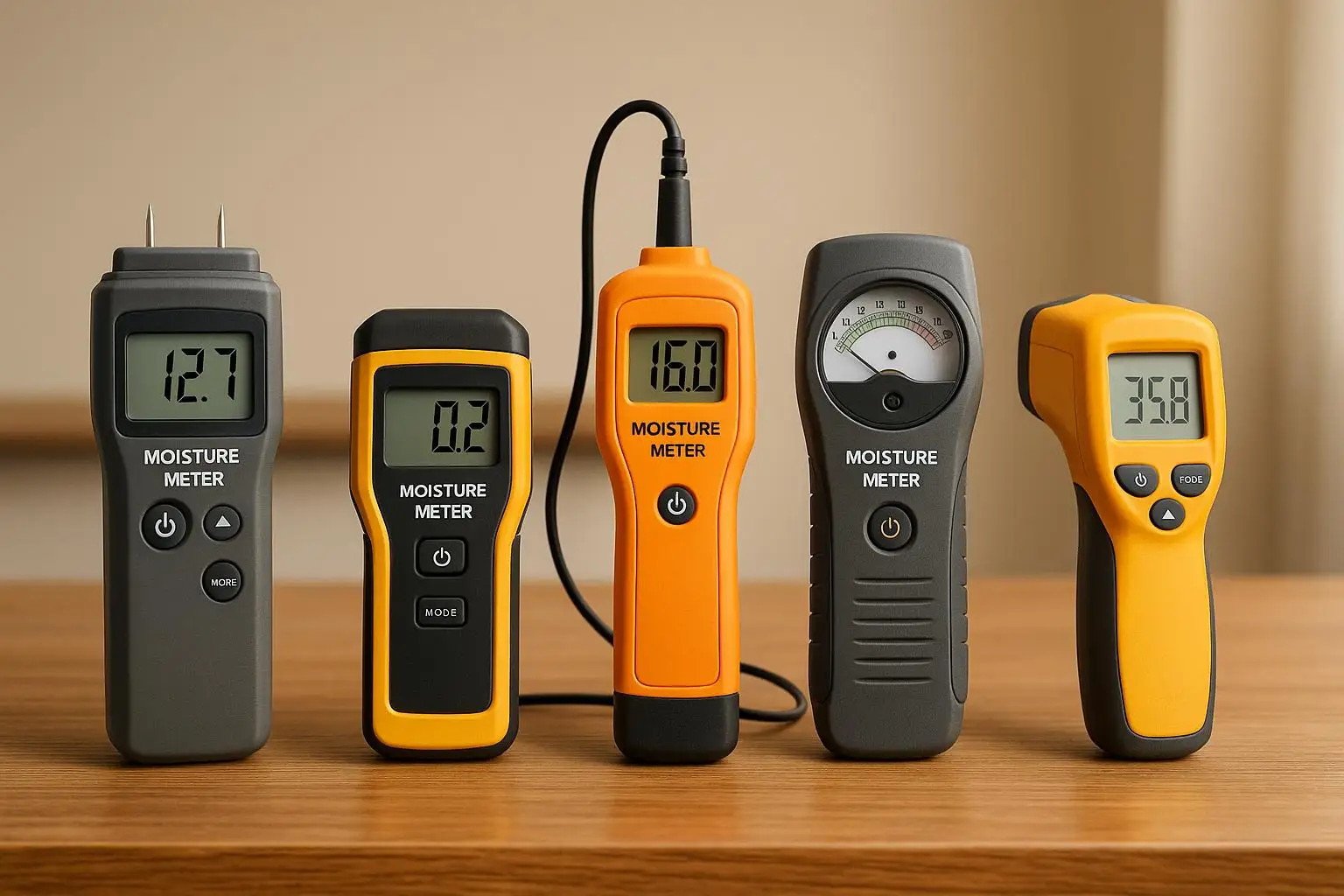
A moisture meter tells you whether a wall, floor, or stud is still wet after a leak — not whether the room “feels dry.” Homeowners use one to check a small spill. Restoration crews use several types together to map hidden water and prove a space is dry enough to close.
If you already own a meter and want the basics of how a reading works, see what a moisture meter measures. The five types below are what we actually use on water jobs in South Florida.
Here are the five main types and when each one helps:
- Pin-type meters: Precise readings by inserting pins; they leave small holes.
- Pinless meters: Electromagnetic scan over a larger area; no holes, a bit less precise.
- Combination meters: Pin and pinless in one tool.
- Hygrometers: Air humidity and temperature while a space is drying.
- Infrared / thermal tools: Surface temperature differences that hint at wet areas, without contact.
Each tool answers a different question. A reading by itself is not a drying plan.
Which meter do you need — and when to call us
| Situation | Tool | Next step |
|---|---|---|
| Finished floor or painted wall you do not want to mark | Pinless first | If the scan stays high, a pin reading in an inconspicuous spot confirms it |
| Exposed wood, subfloor, or stud | Pin-type | Compare to a dry piece of the same material in the house |
| You are not sure what you are looking at, or the wet area is bigger than one room | Combination + hygrometer | That is a water damage restoration job — we map, dry, and document for insurance |
| Readings bounce, or the drywall is already swollen / smells musty | Stop DIY metering | Call us. A meter will not dry insulation or a wet air handler |
A store meter is useful for a small, clean spill you caught the same day. It is not enough after a supply-line burst, a slab leak, or water that sat overnight in South Florida humidity.
Tramex Water Damage Restoration Kits Overview | Moisture Meters & Tools for Professionals
1. Pin-Type Moisture Meters
Pin-type moisture meters are known for their accuracy, relying on a method that’s been around since the late 1940s. These devices work by penetrating materials to measure electrical resistance, a technique pioneered with Delmhorst’s ram-type electrode.
How They Work
These meters use two metal pins that are inserted into the material to measure electrical resistance in ohms. The principle is simple: lower resistance means higher moisture levels. However, the measurement depth is limited to how far the pins can go, typically up to 5/16 of an inch.
Versatility Across Materials
Pin-type meters are highly effective for a variety of materials, especially those that naturally absorb and release moisture like wood and drywall. Many professional models come with settings tailored to specific materials – wood, cement, brick, mortar, drywall, and even carpet – ensuring accurate readings across different surfaces.
Common Applications
These meters are invaluable for tasks requiring precision, such as checking moisture levels in wood beams, subflooring, wall studs, and other hidden areas. They’re a go-to tool for water damage restoration.
Surface Impact
One downside of pin-type meters is that they leave small pinholes in the material being tested. While these marks are minor, they can add up if multiple readings are needed for extensive mapping. This can be a concern for high-end wood surfaces or finishes. As moisture detection expert Chris Ranwell explains:
"To be sure, while pin-type meters do leave a small mark on materials like hardwoods, plaster, or concrete, the damage is minimal and hardly noticeable."
In professional restoration, the trade-off between slight surface damage and highly accurate readings often justifies using pin-type meters. For situations where preserving the surface is a priority, technicians may start with pinless meters for an initial scan before switching to pin-type meters for detailed testing. Up next, we’ll explore a non-invasive option for scenarios where protecting surfaces is paramount.
2. Pinless Moisture Meters
Measurement Method (Non-Penetrating)
Pinless moisture meters rely on electromagnetic waves to scan surfaces without causing any damage. By measuring a material’s conductance – using either radio frequency or capacitance technology – they can quickly assess moisture levels. This method allows for testing over larger areas in a single pass, delivering faster results overall. The non-invasive nature of this approach makes it suitable for a wide range of applications across different materials.
Material Compatibility
These meters are designed to work with a variety of materials, including wood, drywall, plaster, roofing, tile, and masonry. They can even detect moisture beneath surface coverings like paint, wallpaper, tiles, and shingles. Tramex highlights this versatility in their ME5 model:
"The ME5 detects elevated moisture levels within the most common building materials and is pre-calibrated to the various densities of materials such as drywall, plaster, roofing, tile and masonry."
However, accuracy may decrease when testing materials with high mineral content or inconsistent densities, such as concrete. To ensure reliable results, professionals often take a dry sample reading of the material first to establish a baseline.
Typical Use Cases
Pinless meters excel at quickly identifying moisture pockets up to 0.75 inches deep. Many models can also produce color-coded maps to document affected areas. Tramex describes their role in moisture management:
"The key objective of moisture detection in the Water Damage Restoration industry is to identify and assess the extent of and damage caused by any abnormally wet or damp areas within building structures so that the drying progress can be measured, monitored and documented and the materials restored."
Moisture control expert Grete Heimerdinger adds:
"Moisture meters are used for moisture control to avoid mold build-up and to check moisture in floors, cabinets and other furnishings to avoid cracking, checking and warping."
Potential for Surface Damage
Thanks to their non-invasive design, pinless meters are gentle on surfaces, making them particularly useful for testing hardwood floors, finished surfaces, and other delicate areas. When scanning walls, these devices provide an average reading across their range, which speeds up initial assessments. For more precise boundary detection, many professionals combine pinless meters with pin-type models to get detailed readings where needed.
3. Combination Moisture Meters
Integrated Measurement Method
Combination moisture meters bring together pin-type and pinless technologies in one device, offering versatility for moisture detection. They use non-invasive methods like conductance, radio frequency, or capacitance to quickly scan large areas. When more precision is needed, they switch to electrical resistance measurements through inserted probes. These meters can measure up to 5/16 inch with pin probes and up to ¾–1 inch with pinless scanning. For example, the FLIR combines pinless scanning for a broad overview with pin probes for more detailed readings. This dual functionality simplifies both quick assessments and in-depth inspections, particularly useful in water damage restoration.
Material Compatibility
Combination meters are designed to work on a wide range of building materials. They can detect moisture beneath surface coverings like paint, wallpaper, ceramic tiles, and flooring without causing initial damage. Some models even include specific calibrations for materials such as drywall, water-resistant backerboard, and glass matte panels. This level of precision is critical in water damage scenarios, where the financial impact can be staggering – flood insurance claims exceed $3 billion annually, and just an inch of floodwater can lead to damages of up to $25,000.
Typical Use Cases
These meters are particularly valuable in water damage restoration, as they combine multiple functions in a single tool. Many models also include hygrometer capabilities alongside their pin-type and pinless features. The process typically involves starting with a non-invasive pinless scan to locate affected areas, followed by pin measurements to assess the depth of water infiltration. Moisture expert Grete Heimerdinger highlights the benefits of this approach:
"The best option is given when using a combination pin and pinless meter side by side. Pinless measurements give a quick overview of the affected area, and pin measurements allow to precisely determine the depth of the water infiltration."
At Total Care Restoration, we use combination moisture meters as part of our water damage assessments to ensure an efficient and accurate restoration process.
Potential for Surface Damage
The pinless mode is ideal for initial assessments, as it minimizes surface damage while testing finished surfaces, hardwood floors, or other delicate materials. When more detailed readings are required, the pin function provides precise results with minimal penetration. This dual capability allows restoration professionals to quickly scan large areas and then focus on specific spots with targeted pin measurements. By balancing thorough detection with reduced surface impact, these meters are a practical choice for restoration work.
4. Hygrometers and Thermo-Hygrometers
Measurement Method
Hygrometers and thermo-hygrometers focus on measuring ambient humidity, temperature, and grains-per-pound (GPP) in the air rather than detecting moisture within specific materials. These devices rely on non-invasive techniques, unlike pin-type or pinless meters that assess moisture levels inside materials. Instead, they evaluate environmental conditions, which can help identify areas at risk for moisture-related problems.
Thermo-hygrometers combine the functions of a thermometer and a hygrometer, delivering both temperature and humidity readings at the same time. They also measure the dew point, which helps determine when and where condensation might occur. This additional data complements material-specific readings, offering a broader understanding of potential moisture risks in the environment.
Material Compatibility
These tools measure ambient conditions without making physical contact with surfaces, enabling them to assess moisture risks in walls, tiles, and hidden cavities. Thermo-hygrometers are particularly useful in identifying areas prone to mold growth by detecting high humidity levels that could encourage fungal development. Considering that weather-related disasters have cost the United States $750 billion in just the past five years, tools like these are indispensable for evaluating damage across various building types.
Typical Use Cases
Hygrometers and thermo-hygrometers play a key role in water damage restoration by monitoring environmental conditions. Their applications span three critical phases: pinpointing high-risk areas during initial inspections, tracking drying progress with daily humidity and temperature readings to optimize air movement and dehumidification, and confirming dryness after remediation is complete.
At Total Care Restoration, thermo-hygrometers are an essential part of our Emergency Water Damage Checklist: First 24 Hours process, ensuring precise moisture detection and effective drying verification.
Potential for Surface Damage
Because hygrometers and thermo-hygrometers rely on measuring ambient air rather than making contact with surfaces, they pose no risk of surface damage. This non-invasive approach is particularly valuable for initial inspections and ongoing monitoring, especially when dealing with delicate finishes, antique materials, or other surfaces that require extra care during restoration work.
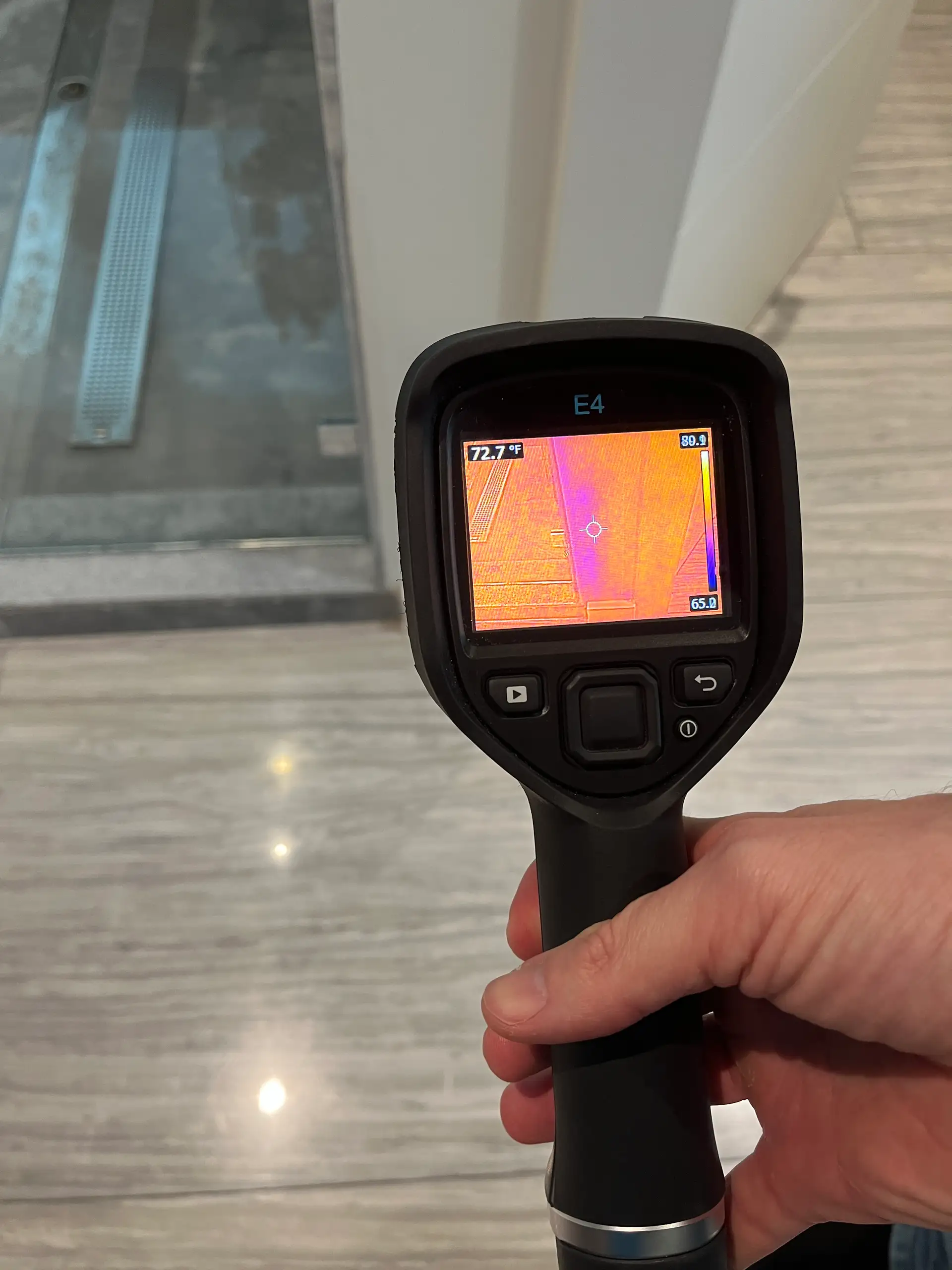
5. Infrared Moisture Meters and Thermal Imaging Tools
Measurement Method
Infrared moisture meters and thermal imaging tools detect moisture by identifying surface temperature differences rather than directly measuring moisture levels. Moisture-affected areas tend to appear cooler in thermal images because water absorbs and retains heat differently than dry materials. These tools produce false-color images, where darker shades signify cooler (and likely moist) areas, while brighter hues indicate warmer, dry zones. This method is adaptable for use with various materials, making it incredibly versatile.
Material Compatibility
Thermal imaging tools excel at measuring surface temperatures across a range of building materials. They are particularly effective for identifying wet insulation and hidden leaks. Their versatility extends to inspections in kitchens, bathrooms, HVAC systems, attics, basements, laundry rooms, and even hard-to-reach spots like crawlspaces and ductwork.
Typical Use Cases
Thanks to their precision and compatibility, these tools are indispensable in restoration work. They help pinpoint moisture intrusion during inspections and play a key role in documenting damage for insurance purposes. Professionals also use thermal imaging for energy audits and to uncover hidden issues behind finished walls. Beyond restoration, this technology is effective for detecting leaks in pipelines, tanks, and machinery.
At Total Care Restoration, certified technicians rely on thermal imaging to quickly identify problem areas and create tailored restoration plans.
"By employing thermal imaging and a moisture meter, inspectors can locate moisture issues before they become large problems and lead to serious damage, as well as gather details in cases where moisture intrusion has already become obvious." – Nick Gromicko, CMI®
For the most accurate results, experts recommend pairing thermal imaging with a moisture meter to confirm potential problem areas.
Potential for Surface Damage
Because these tools operate without direct contact, they allow repeated monitoring without risking surface damage. This makes them invaluable for tracking progress and maintaining documentation during water damage restoration projects.
Comparison Table
Choosing the right moisture meter for water damage assessment means understanding the strengths and limitations of each type. Different tools excel in specific scenarios, making them more or less suitable depending on your needs.
| Moisture Meter Type | Measurement Method | Material Compatibility | Typical Use Cases | Surface Damage Potential |
|---|---|---|---|---|
| Pin-Type | Measures electrical resistance between two pins inserted into the material | Wood, drywall, concrete – provides quantifiable readings | Precise moisture readings in small, localized areas; carpentry work (6–8% for interior, 9–14% for exterior wood) | High – pins penetrate the surface, causing small holes |
| Pinless | Uses electromagnetic waves or radio frequency to measure the dielectric constant | Suitable for various materials, but provides relative readings requiring a dry sample for comparison | Quick surveys across larger areas; initial moisture screening | None – completely non-destructive |
| Combination | Offers both pin and pinless measurement options in one device | Versatile for different materials when using the appropriate measurement mode | Professional restoration work requiring both precise local measurements and broader surveys | Variable – depends on the selected mode |
| Hygrometers | Measures relative humidity in air or within materials | Detects air moisture and material humidity levels | Environmental monitoring and tracking drying progress during restoration | None – non-contact measurement |
| Infrared/Thermal | Detects surface temperature differences to identify moisture areas | Measures surface temperature across various building materials | Detecting Underground Water Leaks Signs Causes And Solutions, insurance documentation, and energy audits | None – operates without direct contact |
Each meter type offers distinct advantages in water damage assessments.
Pin-type meters are excellent for precise measurements, such as verifying drywall moisture levels within a 5–12% range. However, they leave small puncture marks, which may not be ideal for finished surfaces.
Pinless meters, on the other hand, are great for quickly scanning large areas without causing any surface damage. They work best when you establish a dry baseline first. Keep in mind, though, that metal components can sometimes interfere with their accuracy.
Combination meters bring the best of both worlds. They allow technicians to switch between pin and pinless modes, making them versatile for detailed measurements and broader surveys. At Total Care Restoration, for example, technicians use combination meters to streamline their work, reducing the need for multiple tools.
While pin-type meters provide accurate, quantifiable data, pinless meters offer relative readings that depend on a baseline. This is why many professionals rely on several meter types to get a comprehensive understanding of moisture levels.
When selecting a moisture meter, think about the materials you’ll be testing and whether surface damage is acceptable. For instance, if you’re assessing antique wood furniture, a pinless meter is a safer choice. But for structural damage behind walls, a pin-type meter may be necessary for precision. These factors can help guide your decision for effective water damage assessment.
Conclusion
Selecting the right moisture meter is a crucial step in avoiding costly mistakes and ensuring thorough restoration. With water damage contributing to multi-billion-dollar insurance claims and causing significant damage per inch, precise moisture detection is vital – not just for financial reasons but also for the structural safety of your property.
The five types of moisture meters we discussed each play a unique role in water damage assessment. Pin-type meters provide accurate, localized readings, while pinless meters enable quick, non-invasive scans across larger areas. Combination meters offer the flexibility professionals require, and hygrometers monitor environmental conditions during the drying process. Meanwhile, infrared and thermal imaging tools uncover hidden moisture that could otherwise go unnoticed. Together, these tools create a well-rounded strategy for managing moisture effectively.
Precision is everything. As Tom Laurenzi, CEO of Delmhorst, explains:
"As obvious as it may seem, users don’t always have the meter set to the correct scale (wood/species/material vs. reference scale or WME). As important as checking the calibration is, checking for the proper scale is critical".
Improper use or misreading a meter can lead to serious consequences, like mold growth within 48 hours or structural damage when wood moisture levels hit 35-50%. The ANSI/IICRC S500 2021 Standard highlights the importance of proper training, stating that restorers "should be trained in the proper use and application of the meter … and have an understanding of the intended use, limitations, and proper operation of the device". This knowledge ensures restorers can work more efficiently, save time and money, and provide accurate documentation for insurance claims. Every step of a successful restoration process depends on this level of accuracy.
As outlined earlier, detecting moisture accurately is key to preventing mold and structural damage, safeguarding both the integrity and value of your property. Companies like Total Care Restoration use certified technicians and advanced tools to ensure no moisture goes undetected. When moisture levels rise above the normal range of 5-12% or exceed 20%, having skilled professionals equipped with the right tools can make all the difference.
FAQs
What type of moisture meter should I use for different materials in my home?
To find the right moisture meter, start by considering the material you’re working with and how precise your measurements need to be. Pin-type moisture meters are perfect for getting accurate readings on porous materials like wood since they measure moisture beneath the surface. On the flip side, pinless meters are best for non-invasive testing on materials such as drywall, flooring, or finished surfaces.
You’ll also want to factor in the material’s thickness, surface characteristics, and whether leaving marks is a concern. For instance, a pinless meter is a smart choice for delicate finishes or thin materials, while a pin-type meter works better for thicker or unfinished materials where accuracy matters most.
Can a combination moisture meter replace both pin-type and pinless meters?
A combination moisture meter brings together the features of both pin-type and pinless meters, making it a handy tool for assessing water damage. That said, in some scenarios, it might not deliver the same level of precision as meters designed specifically for one method. If your work demands exceptional accuracy or requires avoiding any surface damage, you might find that a dedicated pin-type or pinless meter is a better fit.
What are the challenges of using thermal imaging tools to detect hidden moisture?
Thermal imaging tools are handy for spotting temperature differences that might point to moisture issues, but they aren’t without their flaws. For instance, water often appears cooler in thermal images, which can lead to false readings. On top of that, reflective surfaces or drafts can throw off the accuracy of these devices.
Other factors, like extreme temperatures or being positioned too far from the area you’re inspecting, can further limit their reliability. While thermal imaging is a valuable resource, pairing it with other tools, such as moisture meters, provides a more reliable way to assess hidden moisture problems.
Related posts
Want to Learn More?
Read our comprehensive guide covering everything you need to know about this topic.
The Complete Guide to Water Damage Restoration in South FloridaNeed Professional Help?
Our expert team is ready to assist with your water damage restoration needs.
View Water Damage Restoration Services