Real-Time Data in Water Damage Restoration
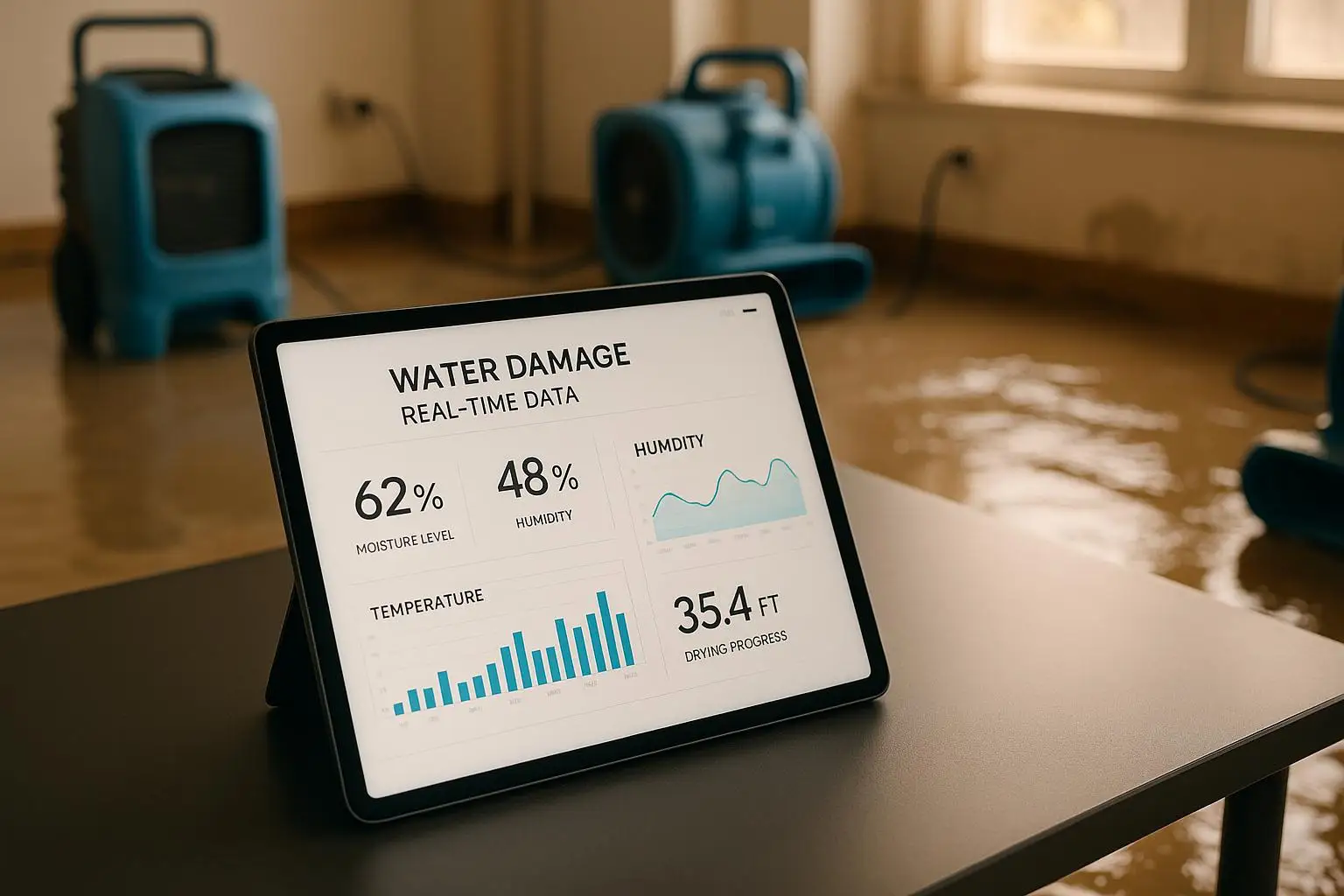
Real-time data is changing how restoration teams handle water, fire, and mold damage. Sensors and automated systems now track humidity, temperature, and air quality issues around the clock.
This technology enables faster, more precise responses. It also reduces costs, improves safety, and creates better documentation for insurance claims.
Key Takeaways
| Type | Benefits | Key Metrics |
|---|---|---|
| Emergency Water Damage Checklist: First 24 Hours | Cuts costs by up to 30%, reduces site visits by 70% | Humidity, temperature, moisture levels |
| Fire Damage Restoration | Reduces response times by 50% | Air quality, structural safety |
| Mold Remediation | Prevents mold spread with constant monitoring | Humidity, temperature, spore counts |
Quick Tip: Save time and money by strategically placing sensors, using AI-powered mapping, and leveraging cloud tools for remote monitoring.
How to Document Water Damage Restoration Like a Pro
1. Water Damage Restoration
Water damage progresses fast. It can cause secondary issues quickly. That's why constant monitoring is essential.
Data Collection Frequency
Sensors gather data every 15 seconds. This high-frequency monitoring detects changes in:
- Moisture levels
- Temperature
- Equipment performance
Benefits:
- Automation cuts manual site visits from hours to minutes
- Remote alerts notify technicians of equipment issues instantly
- Quick action prevents further damage
Metrics Monitored
Four key metrics are central to water damage restoration:
| Metric | What It Tracks |
|---|---|
| Ambient humidity | Indoor and outdoor readings for benchmarks |
| Temperature | Environmental conditions |
| Moisture in materials | What Is a Moisture Meter the Best Measurement in walls, floors, structures |
| Equipment performance | Run times and energy usage |
These metrics feed into digital documentation systems.
Documentation Standards
Cloud-based systems automatically log:
- Time-stamped environmental readings
- Equipment activities
- Restoration milestones
This ensures accurate, verifiable data for insurance claims and compliance. Property owners get real-time updates via mobile apps.
Technology Integration
Modern restoration relies on:
- IoT-enabled sensors
- Mobile apps
- Cloud platforms
Companies like Total Care Restoration use these systems for 24/7 oversight.
AI-powered moisture mapping generates precise digital maps. This technology offers much more accuracy than paper-based methods. It has cut water mitigation times by 30%.
2. Fire Damage Restoration
Fire Damage Restoration a Step By Step Guide requires attention to both air quality and structural safety.
Data Collection Frequency
Unlike water damage (which needs continuous monitoring), fire restoration uses periodic evaluations.
When monitoring increases:
- During equipment operation (air scrubbers, dehumidifiers)
- When real-time alerts indicate particulate spikes
Metrics Monitored
| Metric | Purpose |
|---|---|
| Air quality indices | Measure particles and VOCs |
| Temperature and humidity | Manage odor control, prevent mold |
| Surface contamination | Detect soot and char residue |
| Structural stability | Assess building safety |
A drop in airborne particles after using HEPA filtration shows successful cleaning. Stable temperature and humidity support odor management.
Documentation Standards
Automated systems follow IICRC standards. They log:
- Air quality readings
- Temperature and humidity
- Equipment performance
This documentation proves air quality meets safety standards before re-occupancy. It also simplifies insurance claims.
Technology Integration
Advanced technology enables real-time monitoring.
Tools used:
- IoT-enabled air quality monitors
- Thermal imaging cameras
- Digital hygrometers
- Cloud-based documentation platforms
Battery-powered or GSM-enabled options ensure data collection even during power outages.
Restoration teams get immediate notifications if equipment fails or conditions become unsafe.
3. Mold Remediation
Mold remediation requires constant monitoring (unlike fire restoration's periodic checks).
Sensors update as often as every 15 seconds. They track humidity, temperature, and airborne spore counts. This vigilance is essential for creating conditions that stop mold growth.
Metrics Monitored
| Metric | Target | Purpose |
|---|---|---|
| Relative Humidity | Below 60% | Prevents mold spread |
| Ambient Temperature | Optimal range | Maximizes dehumidifier efficiency |
| Moisture Levels | Declining | Confirms drying progress |
| Airborne Spore Concentrations | Decreasing | Verifies remediation effectiveness |
Documentation Standards
Industry guidelines like IICRC S520 emphasize detailed documentation:
- Environmental conditions
- Remediation efforts
- Mold removal verification
Real-time data tools automatically log metrics. This creates accurate, time-stamped digital records for:
- Insurance claims
- Regulatory requirements
- Client communication
Technology Integration
Advances in technology include:
- Wireless sensors
- Remote monitoring platforms
- Digital documentation tools
IoT-enabled sensors provide real-time alerts when conditions fall outside acceptable ranges. Project managers can oversee operations remotely and generate compliance reports automatically.
Benefits:
- Remote monitoring saves up to 3 hours per site visit
- AI-powered mapping cuts project timelines by up to 30%
- Cloud platforms centralize data for instant access
Benefits and Drawbacks
Real-time data brings opportunities and challenges across restoration types.
Water Damage Restoration
Advantages:
- Cuts project costs by up to 30%
- Reduces site visits by 70%
- Sends instant alerts (e.g., when dehumidifiers are turned off)
Challenges:
- Poor telecommunications at some sites
- High upfront investment for smaller companies
Fire Damage Restoration
Advantages:
- Improves safety with air quality and structural monitoring
- Cuts response times by up to 50%
Challenges:
- Less developed systems than water damage
- Requires specialized, expensive sensors
- Data is harder to interpret
Mold Remediation
Advantages:
- Real-time humidity, temperature, and spore monitoring
- Automated compliance reporting (IICRC S520)
Challenges:
- Accurate spore counting requires advanced, expensive sensors
- Interpreting biological data needs specialized training
| Restoration Type | Key Strengths | Primary Challenges |
|---|---|---|
| Water Damage | 30% cost savings, 70% fewer visits | High initial cost, telecom needs |
| Fire Damage | 50% faster response, better safety | Expensive sensors, complex data |
| Mold Remediation | Continuous monitoring, auto-compliance | Costly sensors, expertise needed |
Insurance Compliance
Benefits vary by type:
- Water damage – Standardized humidity documentation
- Fire damage – Better safety documentation
- Mold remediation – Automated compliance reporting
Technology Maturity
- Water damage systems – Well-established, readily available
- Fire damage monitoring – Requires more customization
- Mold remediation – Reliable environmental monitoring, emerging biological detection
For companies considering real-time data: Water damage restoration offers the most straightforward path to immediate benefits.
Conclusion
Real-time data is reshaping water damage restoration. It offers round-the-clock monitoring of humidity, temperature, and moisture levels. This eliminates uncertainty and makes restoration more precise.
Cost Savings
Restoration companies can achieve up to 30% cost reductions. Traditional manual monitoring required about 3 hours per site visit. Real-time systems eliminate these costs while freeing teams for more projects.
Speed Matters
Water damage can escalate rapidly within hours:
- Mold growth
- Structural weakening
Real-time alerts detect issues immediately:
- Equipment failures
- New leaks
- Rising humidity
Better Insurance Communication
Historical data logging provides detailed audit trails. This ensures compliance and speeds up claims processing.
Getting Started
Step 1: Strategically deploy sensors
- One sensor externally as a benchmark
- Another at the restoration site
Step 2: Use moisture mapping tools
- Identify areas needing extra attention
- Avoid over-drying
Companies like Total Care Restoration show how certified technicians use smart sensors and remote monitoring to streamline operations.
As remote monitoring becomes accessible to smaller companies, early adopters are building stronger client relationships and better financial outcomes.
FAQs
How does real-time data make water damage restoration faster and more cost-effective?
Real-time data allows for quicker decisions and more accurate solutions.
How it works:
- Monitors moisture levels, temperature, and humidity in real time
- Helps pinpoint trouble spots faster
- Fine-tunes equipment settings
- Tracks progress as conditions improve
Cost benefits:
- Prevents over-drying
- Catches hidden moisture
- Avoids unnecessary work
What challenges arise when using real-time data systems for mold remediation?
Challenges include:
- Monitoring humidity, temperature, and air quality is complex
- Conditions change quickly
- Sensors must be precise and dependable
- Data must be actionable for technicians
Systems need to offer clear alerts and recommendations. Fast responses are essential to stop mold spread.
How does real-time data improve water damage restoration?
Real-time data enables quicker, more precise decisions.
What it tracks:
- Moisture levels
- Temperature
- Humidity changes
How it helps:
- Fine-tunes drying processes
- Catches potential problems early
- Guides use of moisture meters, thermal imaging, and dehumidifiers
Speed is everything in water damage restoration. Real-time data provides immediate insights for efficient, effective work.
Related Blog Posts
Want to Learn More?
Read our comprehensive guide covering everything you need to know about this topic.
The Complete Guide to Water Damage Restoration in South FloridaNeed Professional Help?
Our expert team is ready to assist with your water damage restoration needs.
View Water Damage Restoration Services