How to Fill Out a Standardized Damage Assessment Form
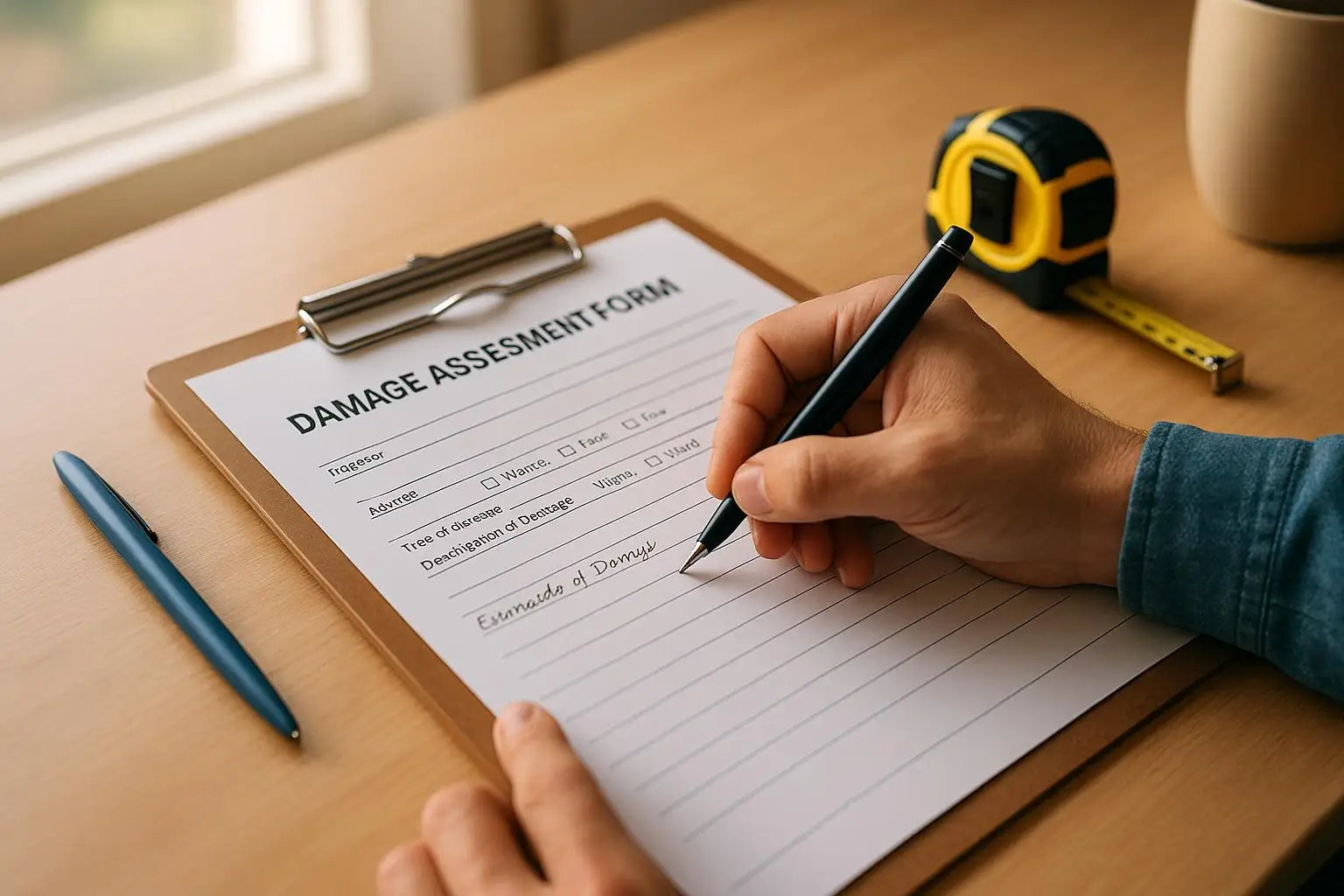
When disaster strikes, documenting property damage accurately is critical for insurance claims and restoration planning. A Standardized Damage Assessment Form simplifies this process by organizing essential details like damage types, severity, and repair costs. Here’s a quick breakdown of what you need to know:
- Key Data: Record dates (MM/DD/YYYY), contact info, address, and GPS coordinates.
- Damage Categories: Classify issues as water, fire, mold, or structural damage with severity levels (e.g., minor, major, destroyed).
- Cost Estimates: Provide repair or replacement costs with sources like contractor quotes or professional evaluations.
- Supporting Evidence: Include clear photos, videos, and written descriptions of damage.
- Safety First: Inspect for hazards like unstable structures or exposed wires before starting.
By using checklists, standardized terms, and reviewing your form thoroughly, you can avoid common errors like vague descriptions or missing information. For complex cases, Commercial can ensure accurate assessments and quicker recovery.
Pro Tip: Digital forms save time, reduce errors, and allow easy submission, making them ideal for modern damage assessments.
Create & Collect Damage Assessment easy using ArcGIS Online
Main Parts of a Standardized Damage Assessment Form
Understanding how a standardized damage assessment form is structured can make filling it out much easier and more accurate. These forms are designed with specific sections that are crucial for insurance claims, restoration planning, and meeting regulatory requirements.
Required Data Fields to Complete
Every standardized damage assessment form includes essential fields that need to be completed for the document to serve its purpose. Start by recording the assessment date in MM/DD/YYYY format and the time in a 12-hour format (e.g., 11/22/2025, 2:30 PM).
Next, provide your full name, contact information (phone number and email), and any relevant credentials. This ensures that insurance adjusters or restoration professionals can easily reach you if they have questions about your assessment.
The location section requires detailed address information, including the street address, city, state, and ZIP code. If possible, include GPS coordinates in decimal degrees (e.g., 40.7128° N, 74.0060° W) to give emergency responders or restoration teams precise location details.
The heart of the form lies in the damage type and severity ratings. Typical damage categories include Emergency Water Damage Checklist: First 24 Hours, Fire Damage Restoration, mold contamination, and structural issues. Severity is often categorized as affected, minor, major, or destroyed.
Cost estimates are another critical component. These preliminary figures for repairs or replacements help insurance companies process claims and allow restoration teams to plan their work. Be sure to specify the source of your estimate, whether it’s based on contractor quotes, online tools, or professional evaluations.
Once you’ve filled out these key sections, use standardized checklists to ensure your submission is thorough and consistent.
Using Checklists and Standard Terms
Checklists and standardized terminology are invaluable tools for reducing errors and ensuring consistency. They simplify the data collection process and make your documentation more reliable.
For instance, standard damage terminology includes material types like wood, steel, concrete, drywall, and flooring. When assessing fire damage, it’s important to differentiate between direct burn damage, Smoke Damage Long Term Effects And Restoration Techniques, and water damage caused by firefighting efforts.
Safety checklists help you address critical concerns such as structural integrity, utility status (electricity, gas, and water), and the presence of hazardous materials like asbestos or lead paint. These checklists ensure you don’t overlook important safety factors that could impact restoration work.
To help prioritize actions, use status indicators such as "immediate repair", "repair within 30 days", "replacement required", or "monitor for changes." These tools reinforce the form’s purpose by ensuring that no critical detail is missed.
Supporting Evidence and Documentation
After capturing the core data, strengthen your assessment by including visual and written evidence. Photos and videos can turn your written observations into compelling proof that supports insurance claims and guides restoration efforts. Each piece of visual evidence should be labeled with the date, time, and location.
Take both wide and close-up photos to clearly show the extent of the damage, such as warped flooring or water stains. Including reference objects like coins or rulers can help highlight the scale of the damage.
Adding personal testimonials can also enhance your documentation. For example:
"Alexander’s team at Total Care Restoration were nothing short of amazing. The team was always on time, respectful, clean. They protected my home as if it was their own to make sure that other damage did not occur. They explained everything in detail and took photos of every step."
Written narratives provide context that photos alone cannot capture. Describe what led to the damage, any immediate actions you took to prevent further harm, and ongoing issues like active leaks or structural instability. Details such as weather conditions, the time of discovery, and any witnesses can also be helpful.
Finally, receipts and repair estimates from contractors or restoration professionals add credibility to your cost assessments. Many digital forms now allow you to upload these documents directly, creating a comprehensive record that’s easy for all stakeholders to access.
For extensive damage that requires specialized expertise, professional Miramar water damage restoration can provide detailed evaluations to complement your initial assessment. Companies like Total Care Restoration, for instance, offer certified technicians who can identify hidden damage and provide accurate cost estimates for services such as water damage restoration, fire restoration, and Mold Remediation.
Step-by-Step Process for Completing the Form
Filling out a damage assessment form requires a careful and organized approach to ensure all necessary information is captured accurately. A structured process not only helps you document everything thoroughly but also keeps safety a priority during the evaluation.
Preparation: Gather Tools and Materials
Before diving into the assessment, make sure you have everything you need. Start with the damage assessment form, whether it’s a digital or paper version. A camera or smartphone is essential for taking photos, and ensure the device is set to record dates in the MM/DD/YYYY format, as required in the U.S.
You’ll also need a tape measure or laser measurer to record dimensions in feet and inches, as well as a flashlight for inspecting dimly lit areas like basements or attics. Safety is key, so bring personal protective equipment (PPE) such as gloves, goggles, and masks to guard against dust or debris. For areas with severe damage, consider wearing a hard hat and steel-toed boots.
Other helpful supplies include a notepad or tablet for jotting down observations that don’t fit neatly into the form, and any reference materials like property blueprints, past inspection reports, or insurance policies that might provide context for the evaluation.
If you’re using digital forms, you’re in luck – these can save significant time. A study by Sitemate found that digital forms can reduce assessment and reporting time by up to 40% compared to paper-based methods. Plus, many digital tools allow offline use, which is invaluable if internet access is disrupted.
Conducting the Initial Site Evaluation
Safety should always come first. Before you start documenting, check for hazards like unstable ceilings, exposed wires, gas leaks, or standing water. If any of these are present, address them or seek professional help before continuing.
Once it’s safe to proceed, begin with photographic documentation. Start with wide-angle shots to capture the overall scope of the damage. These will give insurance adjusters and restoration crews a clear view of the situation at a glance. Follow up with close-up photos of specific problem areas, like water stains, missing shingles, or fire-damaged walls. Include a scale reference in close-up shots to provide context.
Don’t overlook external factors. Record the current weather, temperature, and any environmental conditions that might influence the damage or your assessment. Also, note the time you discovered the damage and the time you’re conducting the evaluation – this timeline can be critical for insurance purposes.
As you move through the property, record initial observations in writing. Include any immediate steps you’ve taken to minimize further damage, such as covering broken windows or shutting off utilities. If there are witnesses who saw the damage occur, document their accounts as well.
This thorough initial evaluation not only ensures a complete record for insurance claims but can also help speed up the restoration process by up to 30%.
Completing the Form Section by Section
Start with the general information section of the form. Be precise – record the date and time in the correct U.S. format and include your full contact details, such as phone number and email, so you’re easy to reach.
For the location details, provide the full address, including street, city, state, and ZIP code. If possible, add GPS coordinates in decimal degrees for pinpoint accuracy, which can be helpful for emergency responders or restoration teams.
When describing the disaster, specify the type of incident (e.g., water damage, fire, storm) and the date it occurred. Use imperial measurements to detail the affected area, such as "basement flooding affected approximately 800 square feet" or "fire damage extends 15 feet along the north wall."
For damage categorization, use standardized terms that insurers and restoration professionals understand. Classify damage as:
- "Affected" for repairable and functional damage
- "Minor" for repairable damage that may pose safety concerns
- "Major" for repairable but unsafe damage
- "Destroyed" for non-repairable, unsafe conditions
When estimating costs, be thorough. Record estimates in U.S. dollars and specify whether they represent repair costs or full replacement values. For example, write "$8,500 repair estimate from ABC Contractors" instead of just "$8,500." Always cite the source of your estimates, whether it’s a contractor quote, an online tool, or a professional assessment.
In the narrative sections, provide detailed descriptions of the damage. Avoid vague statements like "water damage in basement." Instead, write something more specific, such as "water intrusion affected 200 square feet of laminate flooring, 50 linear feet of drywall up to 3 feet high, and electrical outlets on the east wall."
Reviewing and Finalizing the Form
Before submitting the form, carefully review every entry. Cross-check your information with supporting documents and verify calculations for accuracy. Incomplete or incorrect details can delay insurance claims or restoration work. Ensure that dates are in MM/DD/YYYY format, measurements are in feet and inches, and dollar amounts are properly formatted.
Check narrative descriptions to ensure they’re clear and detailed enough for someone unfamiliar with the property to understand the scope of the damage. Avoid using abbreviations or technical terms that could confuse reviewers.
Organize your evidence logically. Number photos sequentially (e.g., Photo 1, Photo 2) and reference these numbers in your form. Arrange receipts and cost estimates in the same order as they appear in your calculations.
For complex issues, such as damage to HVAC systems or structural components, consider having a professional review your assessment. Companies like Total Care Restoration offer certified technicians who can identify hidden issues and ensure your documentation is comprehensive. Their expertise can be especially helpful when dealing with complicated or technical damage.
Finally, ensure your submission looks professional. For digital forms, confirm that all files are readable and properly named. For paper forms, make sure your handwriting is legible and all attachments are securely fastened. Attention to these small details can prevent delays caused by requests for clarification.
Common Problems and Best Practices
When it comes to damage assessment forms, getting it right the first time is essential. Mistakes can slow down claims and delay restoration efforts. By recognizing common issues and following proven practices, you can ensure your forms are accurate and complete.
Problems in Damage Assessment
Missing or incomplete information is a frequent issue. Forgetting to include contact details or attach supporting documents like photos and receipts can stall claims processing. For instance, leaving out fields such as "Estimate Source" or repair costs can disrupt financial planning and reimbursement. In fact, studies reveal that 70% of damage assessments are initially rejected due to missing or incorrect details.
Vague descriptions create another hurdle. A note like "water damage in basement" doesn’t paint a clear picture of the problem. Without specifics – such as the affected materials, the size of the area, or the depth of water – reviewers can’t accurately assess the situation.
Unreliable cost estimates often arise when necessary documentation is absent. For example, submitting a "$5,000 repair estimate" without contractor information can delay the process significantly.
Inconsistent terminology can also lead to confusion. Using terms like "minor damage" in one section and "slight damage" in another to describe the same issue makes it harder for reviewers to understand the severity of the problem.
Best Practices for Accurate Assessments
To avoid these pitfalls, follow these practical tips:
- Stick to standardized terms throughout your report. Use clear, industry-recognized categories like "affected", "minor", "major", and "destroyed" to describe the extent of damage.
- Double-check your data by cross-referencing multiple sources, especially for cost estimates. Always document where and when the information was obtained.
- Organize supporting documents by labeling them clearly. For instance, number photos sequentially (e.g., Photo 1, Photo 2) and reference them directly in your descriptions to help reviewers connect the dots.
- Use digital templates to prevent omissions. Many tools include prompts for required fields, speeding up data collection by 30% and reducing manual errors by 25% compared to paper forms.
- Be specific in your descriptions. Include measurements (in feet and inches), material details, and installation dates. For example, instead of saying "flooring damaged", write "200 square feet of laminate flooring installed in 2019 affected by water intrusion."
- Collaborate on reviews before submitting forms. A second set of eyes can catch mistakes and inconsistencies, especially in complex cases involving multiple types of damage.
Digital vs. Paper Forms: A Comparison
Your choice of format – digital or paper – can greatly influence the efficiency and accuracy of your damage assessments. Here’s a quick comparison:
| Feature | Digital Forms | Paper Forms |
|---|---|---|
| Speed | Fast input and real-time submission | Slower, manual processes |
| Accuracy | Built-in checks reduce errors | Prone to handwriting and math errors |
| Data Management | Easy to search, secure storage, auto-backups | Risk of loss and harder to organize |
| Accessibility | Usable offline and remotely | Requires physical presence |
| Customization | Flexible fields and automatic calculations | Limited to static layouts |
| Cost Calculation | Automated to prevent errors | Manual and error-prone |
Digital tools shine in disaster scenarios where connectivity might be spotty. Many apps work offline and sync data once a connection is restored. That said, paper forms still have their place, particularly when technology isn’t an option or traditional methods are preferred.
For extensive damage or technical challenges, it’s smart to bring in Careers. Companies like Total Care Restoration specialize in services such as water and fire damage restoration, mold remediation, The Future of Restoration Innovations in Water Fire And Mold Remediation, and roof tarping. Their expertise not only helps identify hidden issues but also ensures your documentation meets industry standards. This thorough preparation can save time, reduce errors, and help professionals focus on resolving even the most complex damages efficiently.
When to Call in Professional Restoration Services
While you might handle some damage assessments yourself, certain situations call for the expertise of certified professionals. Knowing when to bring in restoration specialists can save time, prevent costly delays, and ensure every issue is documented accurately. Their expertise complements the detailed documentation required for damage assessments.
Benefits of Professional Damage Assessment
Spotting hidden damage. Certified restoration professionals are trained to identify issues that might go unnoticed, like structural problems, mold hidden behind walls, or moisture trapped in materials. Using advanced tools, they can uncover up to 30% more damage compared to standard assessments.
Simplifying insurance claims. Professionals understand the documentation insurance companies require and ensure compliance with state regulations. Whether it’s a PA-1 or PA-2 worksheet for public assistance claims or forms for residential damage, their familiarity with these processes helps streamline claims.
Direct insurance billing means no upfront costs. Many restoration companies work directly with insurers, allowing repairs to start immediately without requiring out-of-pocket payments. This avoids financial delays and ensures repairs meet insurance standards.
Quick action limits further damage. Many professional restoration companies offer 24/7 emergency services, responding quickly to secure properties and take immediate action, such as water extraction or roof tarping. Addressing damage within 24 to 48 hours can significantly reduce restoration costs compared to delayed responses.
Some situations demand immediate professional attention due to safety risks or complexity. For example, structural damage, severe water damage with hidden moisture, fire damage, or disaster-level events affecting entire properties should always involve certified experts. Properties with multiple types of damage – like fire and water – require coordinated efforts that only professional teams can provide.
Why Choose Total Care Restoration
Total Care Restoration offers expert assessments and prompt restoration services that adhere to strict industry standards. Their certified technicians handle water damage restoration, fire restoration, mold remediation, commercial restoration, and roof tarping, ensuring all damage is addressed by a single experienced team.
By calling their emergency service line at (786) 610-6317, you’ll connect with professionals who understand that timing is critical. Acting quickly helps prevent secondary damage and protects your property’s value during those crucial first hours after an incident.
Total Care Restoration also simplifies the financial process by offering direct insurance billing, so repairs can start right away without upfront costs. This approach reduces the risk of claim disputes and ensures all work meets insurance requirements.
Their certified technicians bring the specialized training needed for accurate damage assessments and thorough documentation. They know how to categorize damage correctly and use standardized forms and tools to create evaluations that meet regulatory and insurance standards.
With a comprehensive suite of services, Total Care Restoration eliminates the hassle of managing multiple contractors. Their coordinated efforts ensure consistent quality and seamless restoration, no matter the type or extent of damage.
For emergency help or to schedule a professional assessment, contact Total Care Restoration at (786) 610-6317. Their team is ready to provide the expert evaluation and support necessary to get your property back on track.
Conclusion
Effective damage assessment relies on a few key principles: preparation, precise documentation, and a thorough review process. To ensure success, start by gathering the right tools, documenting everything clearly, and carefully reviewing each detail. Key actions include conducting a comprehensive site evaluation, capturing clear, dated photographs, and completing all sections of assessment forms systematically with standardized terminology.
Accuracy cannot be overstated – it’s the backbone of a smooth recovery process. Mistakes can lead to delays and even reduced insurance settlements. Clear, time-stamped photos, comprehensive checklists, and a final review of all entries can help avoid these pitfalls. In fact, final checks can catch nearly 30% of preventable errors, ensuring the process is as efficient as possible.
Digital forms have revolutionized the process by offering speed, reducing errors, and providing secure cloud storage. Features like automatic calculations and standardized fields minimize manual mistakes, making assessments more reliable and efficient.
For severe or complex damage, certified restoration professionals are invaluable. They bring the expertise needed to identify all forms of damage and ensure documentation aligns with insurance and regulatory standards. Whether dealing with structural issues, hidden moisture, fire damage, or multiple types of destruction, their skills ensure nothing is overlooked. Their familiarity with insurance protocols and direct billing options can ease financial burdens and speed up the restoration process.
Timing is critical – acting within 24–48 hours can significantly reduce costs and prevent further damage. For emergencies requiring immediate professional assistance, Total Care Restoration offers 24/7 services at (786) 610-6317. Their certified technicians handle everything from thorough documentation to coordinating the entire restoration process, ensuring peace of mind when it’s needed most.
FAQs
What details should I include when estimating repair costs on a damage assessment form?
When filling out a damage assessment form to estimate repair costs, it’s important to include all the necessary details to ensure the estimate is as accurate as possible. Begin by describing the type and extent of the damage – whether it’s caused by water, fire, or structural issues – and specify the areas impacted, such as walls, floors, or ceilings.
Next, break down the labor and material costs, noting any specialized services that may be needed, like mold inspection or Roof Tarping Completely Explained. Include precise measurements, quantities, and unit costs whenever applicable, and take the time to double-check your calculations to avoid errors.
For additional support, you might want to consult professionals like Total Care Restoration, who are experienced in damage restoration and can offer expert advice. A thorough and accurate estimate not only simplifies the repair process but also helps ensure you receive the proper reimbursement from your insurance provider.
How can digital forms make filling out a damage assessment form more accurate and efficient?
Switching to digital forms can make filling out a damage assessment form much more accurate and efficient. These tools often come with handy features like auto-fill, drop-down menus, and error-checking functions, which help minimize errors and ensure every required field is completed properly.
On top of that, digital forms are easy to submit, store, and share, cutting down on the time spent dealing with manual paperwork. This faster process means quicker communication with restoration experts, such as Total Care Restoration, and ensures the details are readily accessible for insurance claims or any necessary follow-ups.
When should I consider hiring professional restoration services during the damage assessment process?
When dealing with extensive damage, safety hazards, or situations requiring specialized knowledge, professional restoration services are a must. Scenarios like water damage, mold infestations, or structural problems often demand expert evaluation to ensure the issue is properly assessed and resolved.
Total Care Restoration provides round-the-clock emergency services. Their certified technicians are equipped to quickly assess and address damage, working efficiently to help bring your property back to its pre-damage state.
Related Blog Posts
Want to Learn More?
Read our comprehensive guide covering everything you need to know about this topic.
The Complete Guide to Water Damage Restoration in South FloridaNeed Professional Help?
Our expert team is ready to assist with your water damage restoration needs.
View Water Damage Restoration Services