Water in the Attic After a Storm: What to Check Before the Ceiling Fails
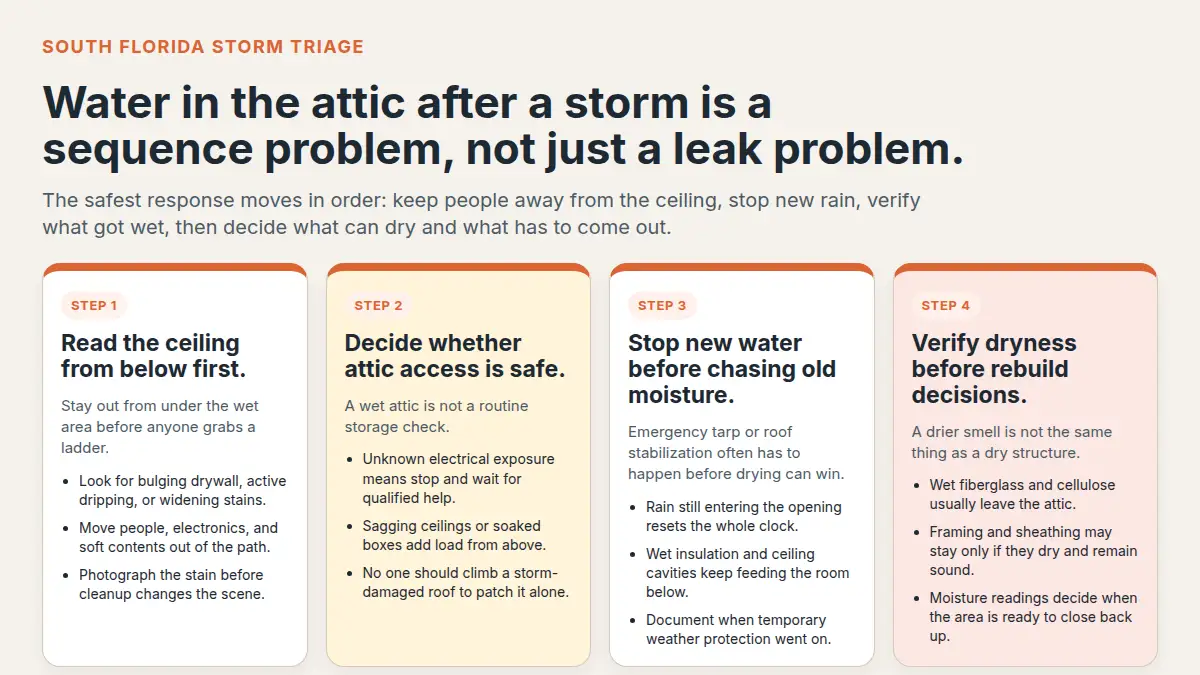
Water in the attic after a storm usually looks smaller than it really is. By the time a stain shows on the ceiling below, rain may already have traveled along rafters, roof decking, insulation, and wall cavities. Total Care Restoration's roof leak guidance for South Florida homes makes that point clearly: water can move through the attic before it ever becomes visible in the living space.
That is why the first question is not "How bad does the spot look?" It is "What is safe to check, what still needs to be protected from new rain, and what is likely holding moisture above the ceiling right now?" TCR's broader storm damage restoration guide and water damage restoration guide treat storm recovery as a sequence: stabilize the source, document the loss, protect people and contents, then verify drying before rebuild decisions are made.
Use this article as a practical triage guide for that sequence. It is written for property owners who need to understand what to observe safely, when attic access becomes a bad idea, and how temporary roof protection, wet insulation, and moisture verification fit together.
| If you notice this first | Better first move | Why it matters |
|---|---|---|
| Ceiling stain that suddenly grows during or after heavy rain | Keep people and valuables out from under it, then document it | The stain is often behind the leak path, not directly under the roof opening |
| Bulging drywall, ceiling sag, or active dripping | Treat the area as a safety problem before a cleanup problem | Wet ceilings and stored attic contents can add weight fast |
| Damp attic smell or wet insulation after a storm | Focus on source control and drying, not only on visible puddles | Insulation and cavities can keep feeding moisture long after the rain slows |
| "The room looks better now" after one dry day | Verify with drying data before rebuilding | Appearance does not prove the attic, ceiling cavity, or framing is ready |
A storm attic leak is safest to handle in order: protect people below, stop new rain from entering, remove what keeps holding water, then verify dryness before closing anything back up.
Why attic leaks get worse before the stain looks serious
A ceiling stain is often a lagging indicator.
TCR's roof leak page explains that water can travel along rafters and roof decking before it drips into visible living-space areas. That means the brown spot on the ceiling may be the end of the path, not the beginning. By the time you see it, the attic insulation above it may already be wet, the ceiling cavity may be holding moisture, and nearby framing may have taken on water even if only one room looks affected from below.
The same logic shows up in TCR's storm guide. The company warns that unsecured roof damage quickly turns into secondary damage, and that hidden moisture inside walls and roof assemblies can keep worsening after the storm passes. The guide also notes that mold can begin growing within 24 to 48 hours if drying does not start quickly.
That timing matters because owners sometimes lose a day or two to the wrong question. They ask whether the stain is large enough to worry about. A better question is whether the building is still taking on water and whether porous materials above the ceiling are now acting like a sponge.
This is also why small visual changes can be misleading:
- one active roof opening can feed more than one room
- wet insulation can keep moisture trapped even after dripping slows down
- one ceiling stain can be downstream from a much wider attic spread
- repeated rain events can reset the drying clock before the first response has a chance to work
If the leak happened during a storm, treat it as an assembly problem, not a cosmetic problem. The roof opening, attic cavity, insulation layer, ceiling material, and room below are all part of the same event now.
What to check from below before anyone touches the attic
The safest first pass usually happens from the floor, not from the attic hatch.
Start with people, contents, and documentation. TCR's water damage restoration guide recommends photographing affected areas before cleanup begins, protecting valuables, and shutting power to affected areas if it is safe to do so. The Mass.gov quick reference for water-damaged buildings adds another useful rule: move staff, clients, visitors, or occupants away from impacted areas and use barriers or signs to limit access when needed.
From below the ceiling, look for:
- Active change. Is the stain spreading while it rains? Is there dripping, bubbling paint, or new dampness along walls?
- Visible ceiling movement. Wet plaster, sheetrock, and ceiling tiles get heavy. Nashville's drying-out guidance specifically warns that bulging ceilings may be holding trapped water.
- Belongings in the path. Move electronics, soft goods, paper files, and furniture before the ceiling cavity releases more water.
- Utility proximity. If the wet area is near light fixtures, recessed cans, outlets, or powered equipment, the problem is no longer just drywall.
The goal of this first inspection is not to diagnose every wet material. It is to decide whether the space below is safe enough to occupy, whether immediate protection is needed, and whether you need to keep anyone away from the room entirely until conditions are verified.
Avoid a common mistake here: waiting until morning because the spot does not look dramatic yet. If the roof opening is still active, every hour of new rain adds more to the attic and more weight to the ceiling below.
When attic access becomes unsafe
Many owners assume that checking the attic is the obvious next step. Sometimes it is not.
Nashville's guidance says to address health and safety concerns first, to assume power lines are live until you know otherwise, and to avoid entering if personal safety feels uncertain. TCR's water damage guide says the same basic thing in simpler terms: if water is near electrical outlets or systems, turn off power only if you can do it safely without stepping into danger.
For a storm-related attic leak, attic access becomes a bad idea quickly when any of these are true:
- you do not know whether electrical components, wiring, or fixtures got wet
- the ceiling below is sagging or visibly loaded
- the attic contains water-soaked boxes or stored materials adding weight
- rain is still entering through the roof opening
- the route into the attic requires stepping onto questionable framing, wet decking, or obstructed access
This is where readers get frustrated, because the attic feels physically close. But storm damage is full of situations where "close enough to look" is not the same as "safe enough to inspect."
Climbing onto a storm-damaged roof is even less forgiving. TCR's roof tarping page explicitly advises against DIY roof work on damaged structures and says professional installation matters because the job involves safety setup, proper coverage, secure anchoring, and documentation. Even if your goal is only to peek at the damaged area, the risk is not limited to slipping. You may also misread how wide the opening is or fail to stop the actual leak path.
If you cannot answer the utility, ceiling-load, and active-rain questions confidently from safe positions below, that is usually the point where trained help stops being optional and starts being the safer choice.
What wet insulation means for ceilings and drying
Wet insulation changes the job because it keeps holding water even after the room below feels calmer.
Nashville's guidance says drying efforts should start at the top of the building and that if attic insulation is wet, it should be removed and disposed of properly. It also explains why: after insulation gets wet, it often becomes ineffective, continues holding moisture for a long time, and can create high-moisture conditions that keep damaging nearby materials. The same document warns that water-soaked items stored in the attic can add enough weight to crack ceilings below.
The Mass.gov building-water-response guide reinforces the timing side of that decision. It says porous materials should be dried within 24 to 48 hours when possible, and if they cannot be dried in that window, mold growth may occur and removal may be necessary. It also says wet insulation should be discarded so the cavity can dry before reconstruction.
The older but still useful DOE Repairing Roofs and Ceilings guide adds a helpful materials distinction:
- soaked fiberglass batt and cellulose insulation should be removed and discarded
- wet framing members and trusses may often stay if they are not obviously damaged or warped
- sheathing may sometimes remain if it was not soaked too long and still dries back sound
That distinction matters because storm-response frustration often comes from seeing some materials stay while others leave. To a homeowner, it can feel inconsistent. To a drying plan, it is logical. Insulation that keeps holding moisture or loading the ceiling is often slowing the whole recovery. Structural wood, by contrast, may be worth drying and monitoring if it is still sound and can be verified before it is covered again.
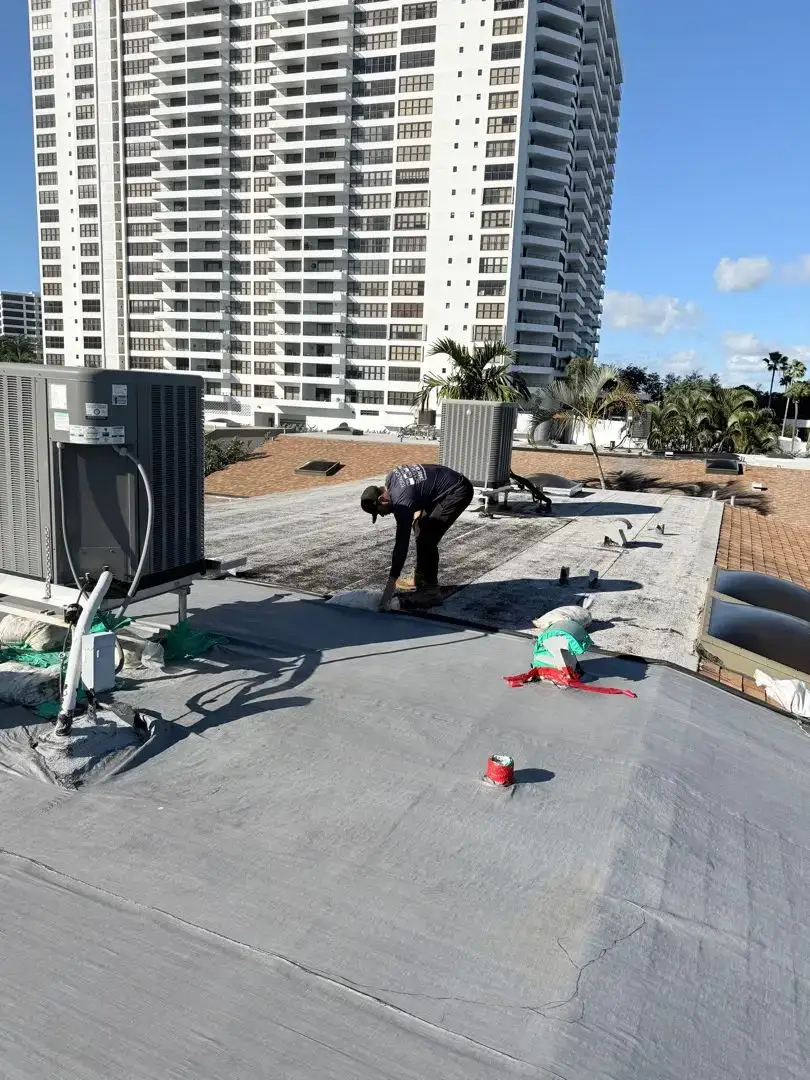
Temporary roof protection matters because drying cannot get ahead while new rain keeps entering the attic and ceiling cavity.
Wet insulation also changes what "progress" looks like. If crews remove saturated insulation, the room below may temporarily look worse because the hidden assembly is finally exposed. That does not mean the job is going backward. It often means the drying process has finally moved from appearances to actual moisture control.
How temporary roof protection and documentation fit together
Storm attic leaks rarely resolve with drying alone. If the roof opening is still active, source control has to happen first or at least in parallel.
TCR's roof tarping page says professionally installed tarps are a temporary measure, not a repair, and that they can often buy roughly 30 to 90 days of protection depending on weather, material quality, and installation method. The storm guide makes the practical point behind that number: preventing secondary damage is part of the response. If more rain is expected, temporary roof protection may be what keeps a manageable attic leak from becoming a wider ceiling, wall, and contents loss.
Documentation belongs in the same step, not later. TCR's storm and water-damage guides both tell owners to photograph damage before cleanup changes the scene. That means:
- wide room shots showing where staining or dripping started to appear
- close-ups of active ceiling damage, wet contents, and visible attic issues if they can be safely photographed
- photos showing what was moved or protected
- timestamps around when tarping or other temporary protection was installed
If insurance becomes part of the conversation, those facts are easier to use when the file shows sequence. What did the room look like before cleanup? When was the roof opening temporarily protected? What was still wet after the first response? Which materials were removed because they were holding water or had missed the drying window?
This is also where owners should separate three different ideas that often get blurred together:
- Temporary weather protection stops new rain.
- Mitigation and drying handle the water already inside the building.
- Permanent repair restores the roof assembly after the emergency is stabilized.
Those are related steps, but they are not interchangeable. A tarp does not dry the attic. Fans do not close the roof opening. A repaired shingle or patched area does not automatically prove the insulation and ceiling cavity below are dry enough to rebuild.
How pros verify hidden moisture before the ceiling gets closed up again
The room below may look normal long before the attic and ceiling assembly are ready.
TCR's moisture meter guide says a meter tells you whether a wall, floor, or stud is still wet, not whether the room feels dry. The article explains how pinless meters help scan larger areas, pin meters give precise localized readings, hygrometers track humidity and temperature, and thermal tools help identify moisture patterns that still need confirmation.
That matters in attic leaks because the visible stain is only one part of the picture. The wettest material may be:
- insulation above the stain
- roof sheathing near the original opening
- framing that carried water laterally
- the ceiling cavity itself
- adjacent drywall or wall tops that never dripped visibly
TCR's water-damage guide says hidden moisture often sits behind walls and under floors, and that standard drying commonly takes about 3 to 5 days for moderate losses. EPA's mold remediation guidance adds the broader warning: wet or damp materials should be dried within 24 to 48 hours when possible, and professional help may be needed to do that quickly and thoroughly.
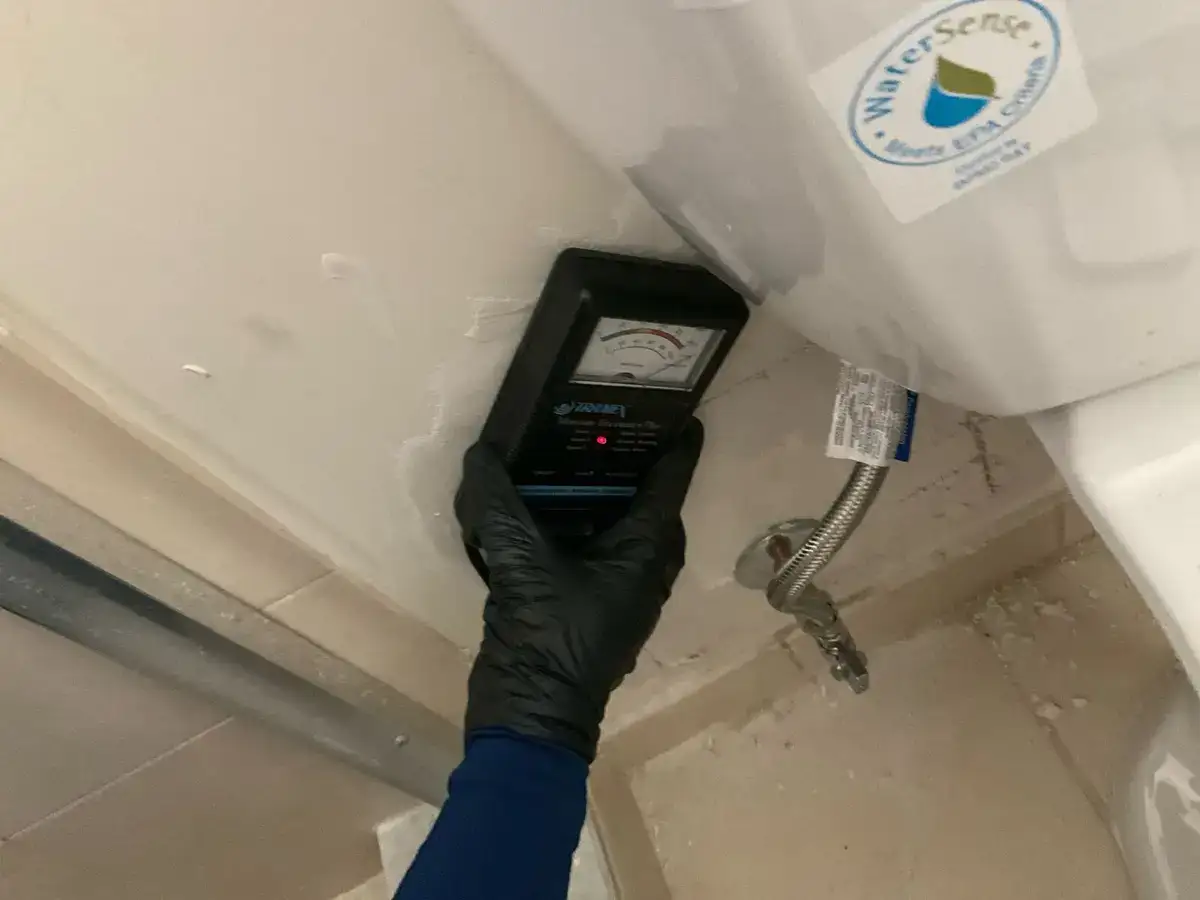
A storm room can smell better before it is actually dry. Moisture readings help decide whether the attic and ceiling are ready for rebuild instead of forcing that call from appearances alone.
That is why rebuild timing should follow drying verification, not impatience. If the roof has been stabilized but the attic still holds wet insulation, elevated readings, or musty air, closing the ceiling early only hides the problem again.
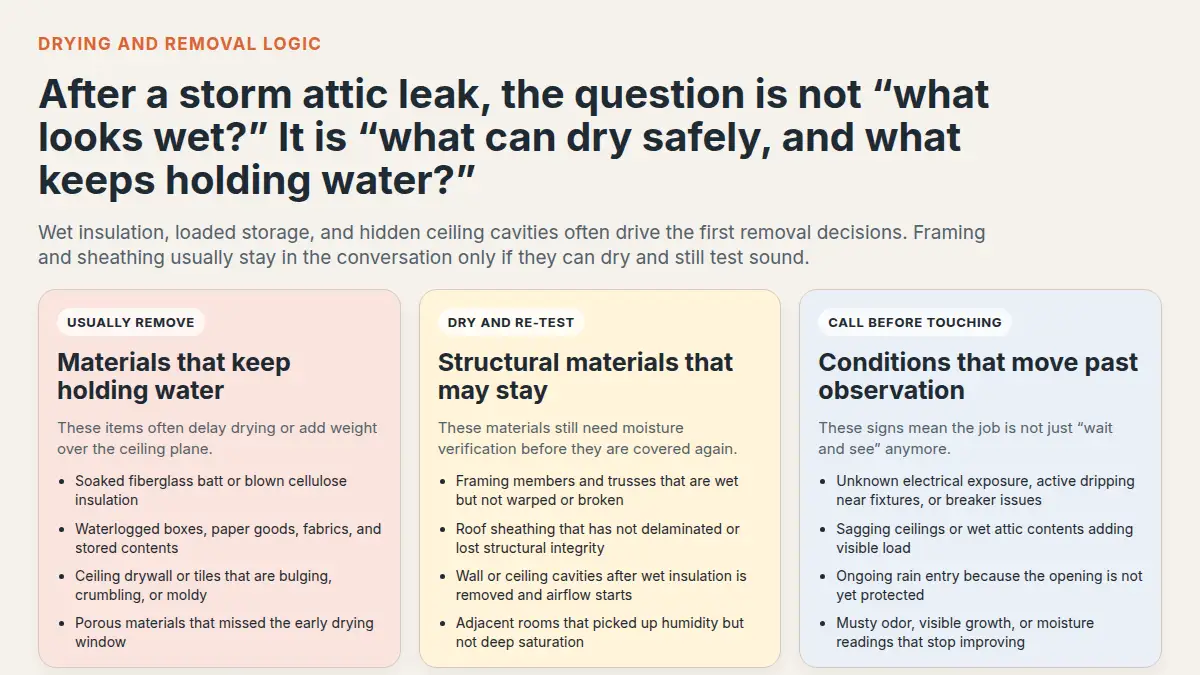
Storm attic leaks become cheaper to understand when owners separate three buckets: what usually has to leave, what may dry and stay, and what should not be touched until a qualified pro verifies the conditions.
When to call a restoration pro instead of monitoring it
Some attic leaks really are small. Many storm attic leaks only look small at first.
Call a qualified restoration team sooner instead of watching and waiting when:
- the ceiling is sagging, bulging, or actively releasing water
- the leak is still taking on rain because the opening is not yet protected
- insulation is wet across more than a small isolated section
- electrical exposure is possible or uncertain
- the musty smell is growing instead of fading
- more than one room or wall line is involved
- you do not have a safe way to verify whether the structure is actually drying
That is the practical value of TCR's storm, roof-leak, and water-damage guidance when read together. Temporary protection buys time. Drying prevents secondary damage. Moisture verification decides when the attic and ceiling can safely move into reconstruction. If any one of those steps is missing, the "small attic leak" can keep expanding after the storm itself is already gone.
Use this article as general education, not as a substitute for an on-site safety or repair assessment. If water is still entering, the ceiling is changing shape, utilities may be involved, or the attic conditions feel uncertain, get a qualified restoration and roofing professional involved before the next rainfall decides the sequence for you.
Want to Learn More?
Read our comprehensive guide covering everything you need to know about this topic.
The Complete Guide to Storm Damage Restoration and Roof Protection in FloridaNeed Professional Help?
Our expert team is ready to assist with your storm damage restoration needs.
View Storm Damage Restoration Services