Renting Equipment for Water Dry-Out and Mold Cleanup: What It Really Takes
Renting Equipment for Water Dry-Out and Mold Cleanup: What It Really Takes
If you are dealing with a soaked floor, a slow leak inside a wall, or musty odors after humidity spikes, searching for rental gear is a rational first step. Big-box stores and local rental yards advertise commercial-style dehumidifiers and carpet blowers (“air movers”) alongside tools you might already know. Renting can absolutely help—but the sticker price on the reservation screen is rarely the whole story.
This guide explains what homeowners usually rent, shows real published list prices from South Florida rental desks (plus a Tampa Bay benchmark), clarifies why national chain websites often hide numbers until you pick a store, covers common DIY dry-out failures, and outlines realistic time and money ranges. It is general information, not a substitute for onsite assessment; confirm details with your insurer, physician, or qualified professionals when health, sewage, or large-scale damage is involved.
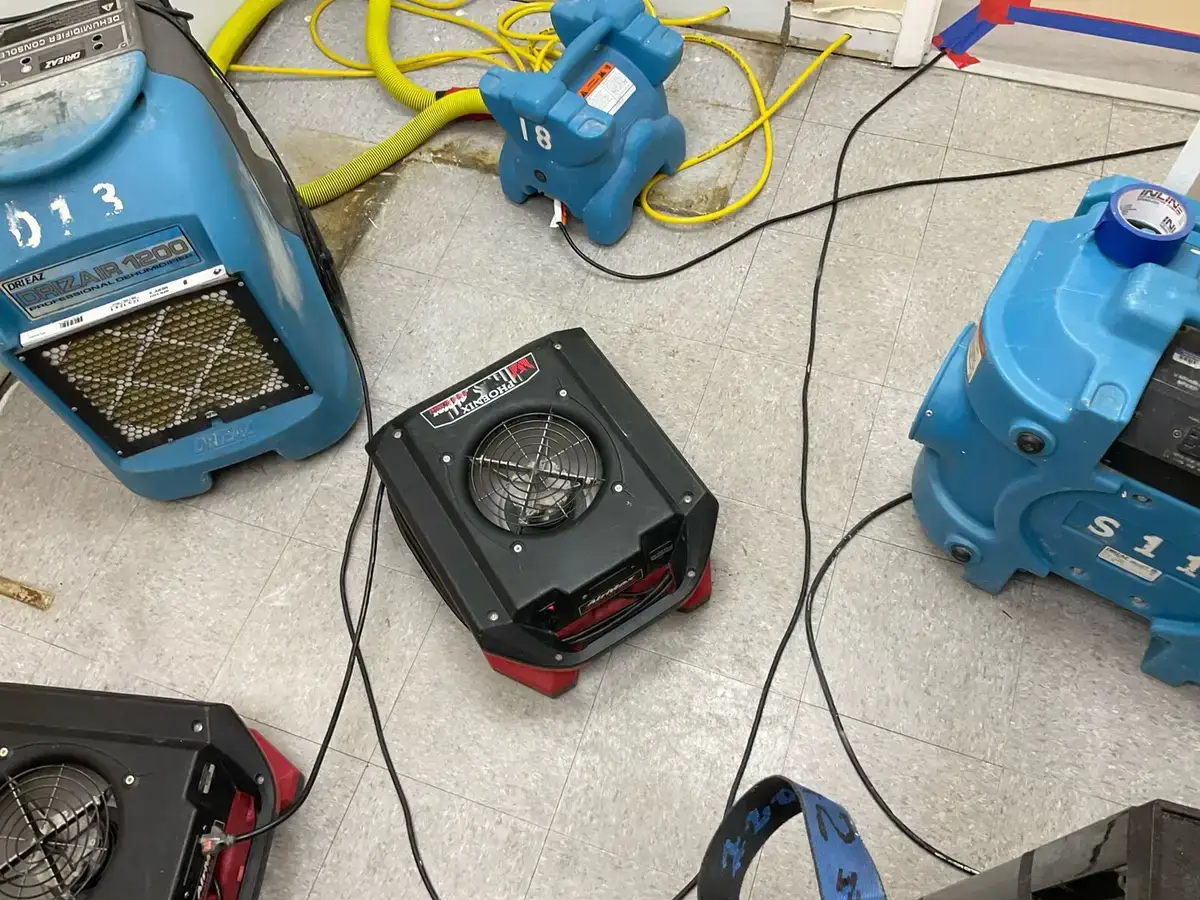
Professional drying setups pair multiple air movers with large dehumidifiers—similar classes of equipment to what rental counters stock for water damage jobs (photo: Total Care Restoration).
South Florida rental price snapshot (published lists — April 2026)
Rates below are printed list prices pulled directly from each vendor’s rental page on the capture date. Taxes, deposits, damage waivers, missing accessories, after-hours fees, and cleaning charges are usually extra—call to confirm what your final ticket will look like.
Local independent yards (Miami–Fort Lauderdale corridor)
All Tool Rental publishes a single dehumidifier category line item online: $77 per day and $306 per week, with the standard disclaimer that prices can change (All Tool Rental — dehumidifier category). Treat the brand/capacity as “confirm at pickup”—their photo is marked reference-only.
Everlast Cleaning Supply maintains a full restoration rental menu with separate lines for air movers, LGR dehumidifiers, HEPA scrubbers, and cavity dryers (Everlast Cleaning Supply — equipment rental price list):
| Gear class | Daily | Weekly | Notes from vendor list |
|---|---|---|---|
| Centrifugal air mover | $8 | $48 | Entry-level blower |
| Velo / Swift flat air mover | $14 | $84 | Mid airflow |
| Axial air mover (example Phoenix Focus class) | $15 | $90 | Higher CFM axial |
| Dri-Eaz DrizAir 1200 | $40 | $240 | Common mid LGR |
| Evolution LGR | $45 | $270 | Low-grain refrigerant step-up |
| 6000Li LGR / Phoenix 200HT LGR | $55 | $330 | Larger LGR classes on their sheet |
| HEPA air scrubber | $38 | — | Filters billed separately |
| Cavity / wall dryer | $30 | $180 | Extra tubing available |
Tampa Bay benchmark (helps bracket South Florida pricing)
True Value Rental Tampa Bay posts e-commerce style pricing for a Dri-Eaz 1200 at $58.59 per 24 hours and $175.77 per week, before taxes and fees (True Value Rental Tampa Bay — Dri-Eaz 1200). That sits between Everlast’s DrizAir 1200 list and All Tool’s posted dehumidifier category—exactly the kind of spread you should expect across counties and dealer formats.
Example DIY stack using published Everlast numbers
For a single wet room with drywall still intact, crews often run one LGR dehumidifier plus two or three air movers. Using Everlast’s list purely as arithmetic:
- Evolution LGR ($45/day) + three centrifugal movers ($8 each → $24/day) ≈ $69/day in equipment rent, before tax and accessories.
- Add a HEPA scrubber on odor or dust-sensitive jobs ($38/day on their list) → $107/day base equipment.
Multiply by the number of days you actually control moisture—many DIY timelines slip because hidden wall cavities stay wet, not because the daily rate changed.
Why Home Depot and Lowe’s prices are not in the table above
Both chains do rent Dri-Eaz-class dehumidifiers and carpet blowers, but their websites usually force you to choose a store (and sometimes rental dates) before showing a rate. Server-side protections on homedepot.com / lowes.com rental pages often block scripted price pulls (the same behavior you may see behind certain VPNs or aggressive privacy tools), so live store selection + screenshot beats any third-party “national average” table.
Practical takeaway: open the rental SKU on your phone, pick the nearest Miami-Dade or Broward store, and screenshot the quote you get—that number is the honest comparable for Home Depot or Lowe’s in your zip code.
What equipment homeowners typically rent for drying
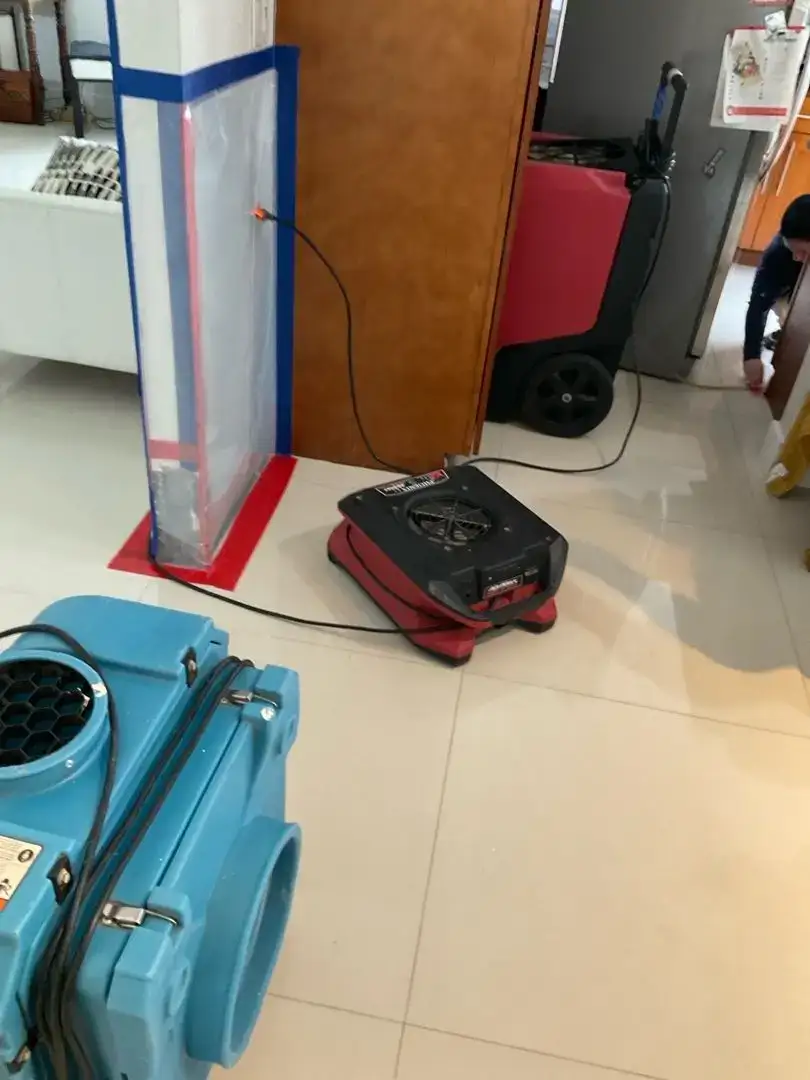
Typical residential drying layout: aim air movers across wet materials and let the dehumidifier pull moisture out of the air—watch circuit loading when you add more fans (photo: Total Care Restoration).
Low-grain refrigerant dehumidifiers (“LGR” or pro dehumidifiers). These are not the small units sold for basements. Rental models are built to pull meaningful moisture even as conditions improve, usually with continuous pump-out to a drain or sink. Stores list capacities such as 18–29 gallons per day removed under test conditions; real performance depends on temperature, airflow, how wet materials are, and whether water is trapped in cavities.
Air movers / carpet dryers. High-velocity fans speed evaporation at surfaces and help dehumidifiers work more efficiently. Many models can be tilted to aim along baseboards or stair treads. Electrical load matters: running several on one circuit can trip breakers.
Moisture meters (sometimes purchase vs rent). Many rental desks focus on movers and dehumidifiers; inexpensive pin or pinless meters are often purchased at the same hardware trip. Knowing “dry to the touch” is not the same as dry per industry drying standards.
Air scrubbers / negative air machines (less universal at big-box). Specialty restoration suppliers and larger rental houses are more likely to stock HEPA scrubbers used with containment for mold work. Availability varies widely by city and season.
Where people rent in South Florida and elsewhere
Home Depot Tool Rental. Widely available in metro areas; product pages describe commercial dehumidifiers and carpet blowers suitable for water damage drying. Rental terms, deposits, and whether pricing appears online are location-specific—expect to select a store or call for rates and availability.
Lowe’s Rental. Lowe’s advertises four-hour, daily, weekly, and four-week rental periods for tools and equipment; inventory differs by store. Some locations emphasize categories like carpet cleaners more prominently online, so for drying-specific gear it pays to call the rental desk and ask for air movers and LGR dehumidifiers by name.
National equipment rental brands. Sunbelt Rentals, United Rentals, and similar firms cater to contractors and often stock higher airflow counts, ducting, larger dehumidifiers, generators, and floor drying systems. They can be strong options when the job is bigger than a single room or when you need delivery.
Independent local yards. Neighborhood rental shops frequently match or beat chain pricing and may bundle advice on what size gear fits your square footage. Trade-off: hours and weekend access vary.
Used purchase / resale. Some homeowners buy used air movers after long jobs. That only pencils out if you already needed multiple weeks of runtime or foresee repeat moisture issues—and you still own storage and maintenance.
How rental pricing works (and why comparisons are messy)
Few chains publish a single nationwide daily rate that stays accurate for every SKU in every county. Typical structures include:
- Periods: four-hour minimums, 24-hour “day,” weekly, and multi-week tiers (Lowe’s publicly describes these tiers for rentals generally).
- Deposits and paperwork: identification, deposit holds, damage waiver options—read the agreement.
- Accessories: extra hose, duct tape, extension cords rated for load, ground-fault protection—sometimes bundled, sometimes extra.
- Pickup and return: your time, vehicle fit, and help loading heavy units.
- Extensions: if drying runs longer than expected, extra days add up fast—often where DIY budgets blow past early estimates.
Because posted prices can differ by store and change with demand, treat any dollar figure you hear from a friend or find in a third-party article as a hint, not a quote—unless you have the vendor’s current list or reservation screen in hand.
How to compare Home Depot, Lowe’s, local yards, and contractor-focused renters
You cannot judge value from brand names alone—only from what is included for the rate you are quoted that week at that counter. Use the same checklist everywhere:
| What to compare | Why it matters |
|---|---|
| Exact equipment class | Two “large dehumidifiers” may differ in capacity, pump-out kit, and whether duct rings are included. |
| Minimum rental span | Four-hour windows help small tasks; drying jobs often run days—weekly tier math changes the true cost. |
| Deposit and ID rules | Holds vary; know before you arrange pickup. |
| Pump hose length and fittings | Longer dry paths to a toilet or washer standpipe may need supplies not in the base quote. |
| Electrical expectations | Ask how many amps a unit draws if you run multiple blowers alongside. |
| Pickup and return logistics | Weight and dimensions affect vehicle choice; rushed returns trigger late fees. |
| Extension policy | If humidity stalls, how fast can you extend without a gap in coverage? |
National tool-rental desks (typical Home Depot / Lowe’s experiences): convenient locations, predictable hours for many suburbs, sometimes faster pickup if inventory sits on hand. Trade-offs can include peak-season waits and a narrower specialty catalog than a restoration-focused supplier.
Large construction rental houses: broader fleets and delivery options for bigger losses; often better when you already know you need scaled airflow, ducting, or multiple coordinated machines.
Independent local yards: flexible staff and competitive weekly rates in many markets; hours may be shorter—verify Saturday policies before you assume a weekend return.
None of these choices replaces moisture verification. The goal of comparison shopping is to avoid paying for the wrong tier of equipment—or paying multiple weekly renewals because the first unit was undersized.
Common problems when drying is harder than it looks
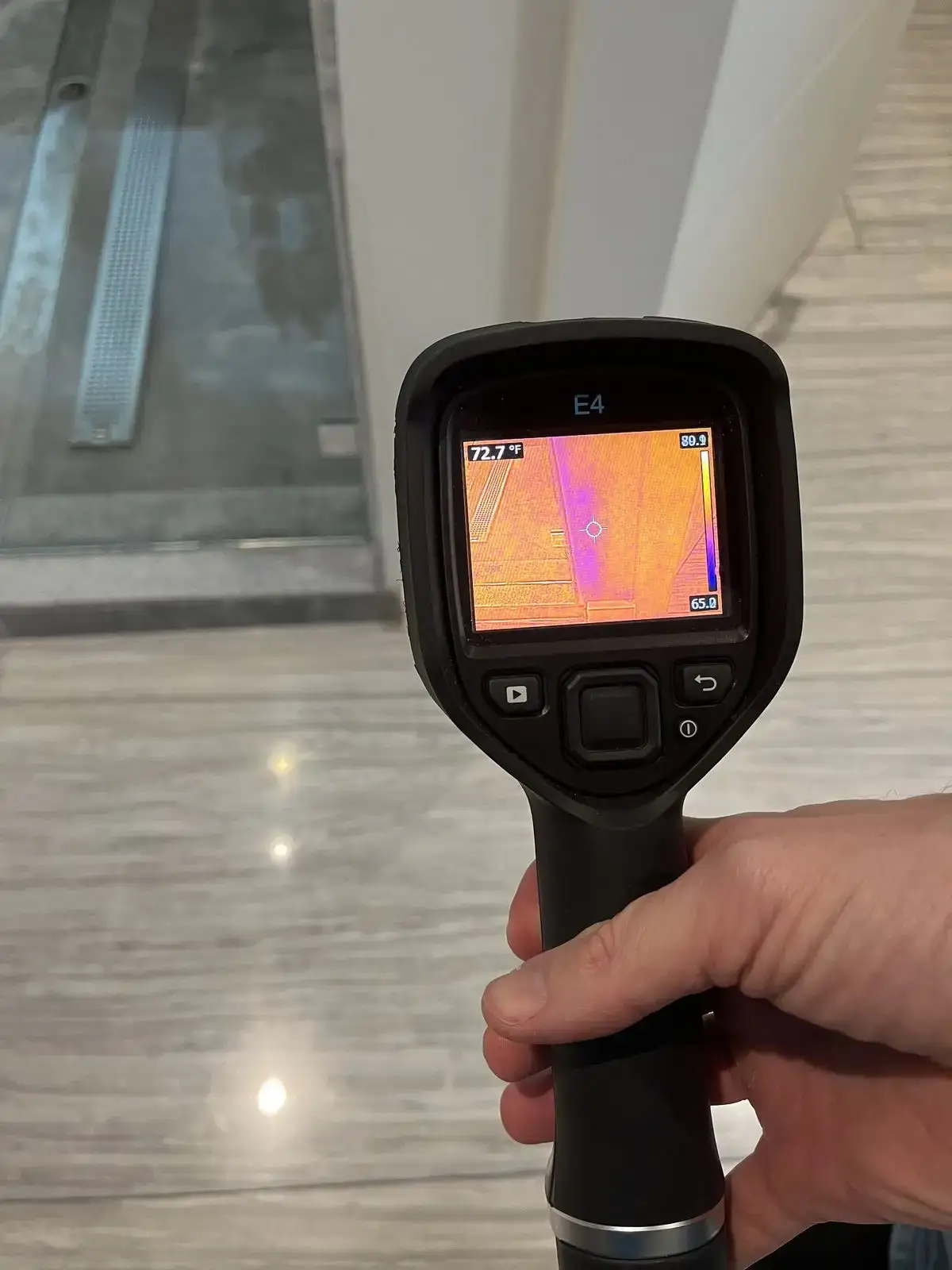
Rental blowers and dehumidifiers only help when you know what is still wet—moisture meters and documented readings beat guessing by touch (photo: Total Care Restoration).
Underestimating trapped moisture. Drywall, insulation, and subfloors can hold water you cannot see. Surface fans alone may leave cavities damp enough for mold—a reason regulators emphasize fixing leaks and drying quickly. The U.S. EPA summarizes that indoor materials should generally be dried within 24–48 hours after a leak or spill to reduce the likelihood of mold growth in many cases (A Brief Guide to Mold, Moisture and Your Home).
Too little dehumidification for the space. One portable unit in an open floor plan after a significant intrusion may run continuously without reaching stable low humidity. You might pay multiple weekly renewals before realizing the capacity was never matched to the job.
Electrical constraints. Older panels, GFCI nuisance trips, long undersized extension cords, and stacking several air movers on one circuit cause frustrating downtime—often interpreted as “bad equipment” when it is really power delivery.
Returning gear wet or dirty. Rental contracts may include cleaning expectations; rushing returns after a muddy crawlspace can mean fees.
Mold scope beyond surface wiping. The EPA notes that areas larger than roughly 10 square feet of moldy surface, significant water damage, HVAC involvement, sewage-related water, or health concerns point toward professional evaluation rather than a simple DIY wipe-down (same EPA guide). Equipment rental does not remove the need for competent assessment when those triggers appear.
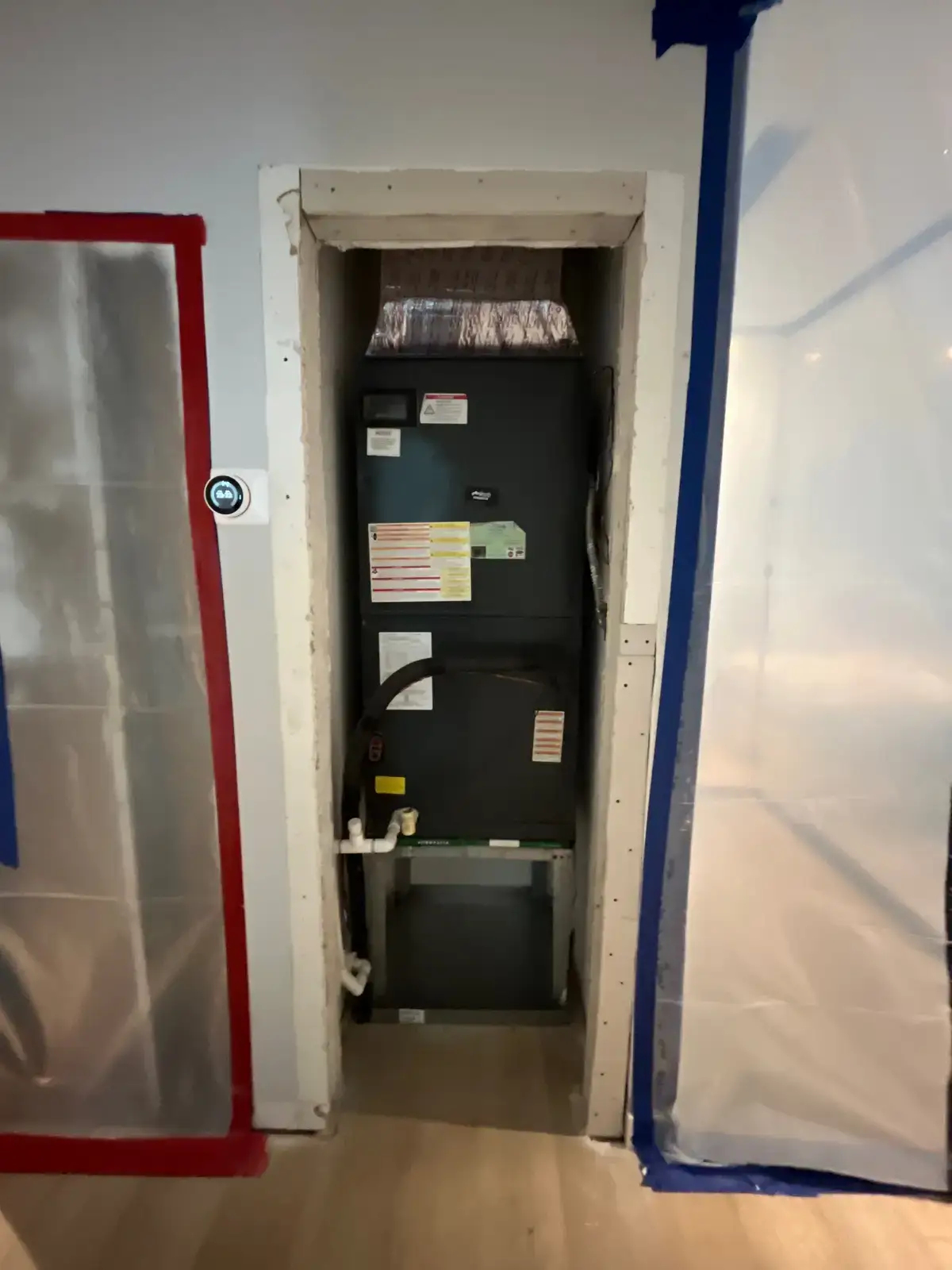
When mold work goes beyond wiping a small patch, containment and air control matter as much as drying equipment—rental HEPA scrubbers do not replace a sound remediation plan (photo: Total Care Restoration).
Spreading particles through the HVAC. If ductwork may be contaminated, running central heating and cooling can distribute particulates. EPA advises caution and appropriate guidance before moving air through a suspect system (A Brief Guide to Mold, Moisture and Your Home).
Total cost: how to budget beyond the day rate
Think in categories, not one number:
- Rental charges for each machine for each period (often dehumidifier plus two or more air movers for even modest rooms).
- Consumables: hose, absorbents, contractor bags, appropriate PPE if you handle contamination—costs scale with area and protocol.
- Electricity: continuous runtime on LGR units is measurable on your utility bill during multi-week dries.
- Opportunity cost: checking drains, emptying overflows if pump-out fails, moving equipment to chase moisture, and coordinating insurance documentation.
- Extension risk: the scenario where day seven was “probably enough,” but materials still read damp on a meter.
If you want a single mental model: small clean-water spill with fast response may end at a modest rental bill; grey or black water, multi-room intrusion, or cabinets and walls involved often multiplies both rental duration and everything around it.
How long drying actually takes
First 24–48 hours: stopping the source, extracting standing water, and getting airflow and dehumidification started matter most for limiting microbial growth risk per broad public-health guidance (EPA guide).
Days to weeks: depth of water, materials involved, whether demolition exposes wet cavities, outdoor humidity, and interior temperature all change the curve. Industry-trained restorers document readings over time; DIY projects sometimes guess based on carpet feel alone.
Plan rental returns with buffer or a vendor that allows clean extensions—unexpected hidden moisture is common when finishes look fine on the surface.
What determined DIYers still miss
- Verification: measuring humidity and moisture content in affected and nearby materials versus guessing by touch.
- Containment thinking: isolating work areas when disturbances could aerosolize dust or spores—especially if someone sensitive will occupy the space.
- Material removal decisions: porous items that stay wet may need to go, even if the surface looks clean later.
- Insurance documentation: photos, dates, moisture logs, and consistent narratives reduce friction if you later file or supplement a claim.
If you want deeper context from our educational library, these guides expand on terminology and process without replacing an onsite inspection: Water damage restoration overview and Mold remediation overview.
Bottom line
Renting an LGR dehumidifier and air movers from a Home Depot, Lowe’s, or a local yard can be part of a sensible response to moisture—provided you match equipment to the loss, respect electrical limits, watch the calendar on rental renewals, and recognize when moisture or mold indicators call for broader expertise than equipment alone.
Confirm pricing, deposit rules, and included accessories with your chosen store or rental house; confirm health and contamination questions with qualified professionals when triggers like sewage, HVAC involvement, large affected areas, or medical vulnerability are present.
This article is for general information only and does not constitute medical, legal, or insurance advice. Confirm equipment specs, pricing, and contracts with your rental provider; confirm mold and moisture decisions with qualified professionals when appropriate.